
Quick answer: An occupancy certificate (OC) is issued by BMC confirming that a building was constructed as per its sanctioned plan and is legally fit to occupy. Without it, Mumbai societies run into penal charges, blocked home loans, stalled deemed conveyance, and real complications during redevelopment.
In short:
- The OC comes from BMC's Building Proposal Department, not from the society or the buyer.
- Getting the OC is legally the developer's job, not the society's, under the Real Estate (Regulation and Development) Act, 2016.
- The Supreme Court has held that a builder's continuing failure to obtain the OC is a continuing wrong, which kept a society's compensation claim from being time-barred.
- A 2026 BMC amnesty scheme now gives many older buildings a real path to getting an OC, though it is still working through early teething trouble.
- Checking OC status takes a few minutes once a society has the right property details.
In this article
- What Is an Occupancy Certificate?
- OC vs CC: A Mix-Up Worth Clearing Up
- Why the OC Matters to a Mumbai Housing Society
- Who Is Responsible for Getting the OC, the Builder or the Society?
- Can a Society Apply for the OC Itself Now?
- How to Check If Your Building Has an OC
- What If Your Building Has No OC?
- A Familiar Scenario
- A Practical OC Checklist for Managing Committees
- Where Tick Boxes Fits In
- The Bottom Line
- Frequently asked questions
What Is an Occupancy Certificate?
An occupancy certificate is the final approval in a building's construction timeline. It is issued by BMC's Building Proposal Department once a completed structure has been inspected and matches its sanctioned plan, including water and sewage connections, fire safety clearance, and structural stability. Under Section 2(zf) of the RERA Act, this is the document that separates lawful occupation from occupying a building before it has formal civic clearance.
It comes after two earlier approvals: the Intimation of Disapproval (IOD), which is the developer's initial permission to build, and the Commencement Certificate, which allows construction to actually start. The OC is the last stage, confirming the finished building is safe to live in.
OC vs CC: A Mix-Up Worth Clearing Up
One confusion comes up constantly in Mumbai specifically. In most of India, and in general real estate conversation, "CC" usually means Completion Certificate, confirming the physical construction is done. But in BMC's own records and processes, CC stands for Commencement Certificate, the permission to begin construction, not to finish it. A separate Building Completion Certificate (sometimes called BCC) and the OC come later.
| Document | Issued when | Confirms | Issued by |
|---|---|---|---|
| Commencement Certificate (CC, in BMC usage) | Before construction begins | Permission to start building work | BMC Building Proposal Department |
| Building Completion Certificate (BCC) | After construction is physically complete | Construction matches sanctioned plan | BMC Building Proposal Department |
| Occupancy Certificate (OC) | After completion and inspection | Building is safe and fit to occupy | BMC Building Proposal Department |
| Part OC | For phased or multi-tower projects | One tower or floor range is fit to occupy | BMC Building Proposal Department |
For a society checking old paperwork, seeing "CC" in a Mumbai file does not mean the building was declared complete. It only means construction was cleared to start.
Why the OC Matters to a Mumbai Housing Society
Property tax and utility charges
Buildings without an OC are frequently billed at higher water and utility rates than buildings with one. One recent industry comparison put non-OC water charges at double or triple the standard municipal rate, a gap that closes once the OC is in hand. Societies should confirm current rates directly with BMC rather than relying on an old figure, since civic charges change.
Home loans and resale
Banks routinely ask for the OC before sanctioning a home loan or processing a resale. Its absence does not always kill a transaction outright, but it slows it down, adds paperwork, and in some cases leads to a straight rejection, which is exactly the kind of delay a resident discovers at the worst possible moment.
Deemed conveyance and redevelopment
An unresolved OC complicates the transfer of land title to the society and later redevelopment approvals, since a new developer inherits the same unresolved compliance gap the original builder left behind. This is one of the more overlooked ways a missing OC keeps costing a society money years after possession, long after the original builder has moved on.
Who Is Responsible for Getting the OC, the Builder or the Society?
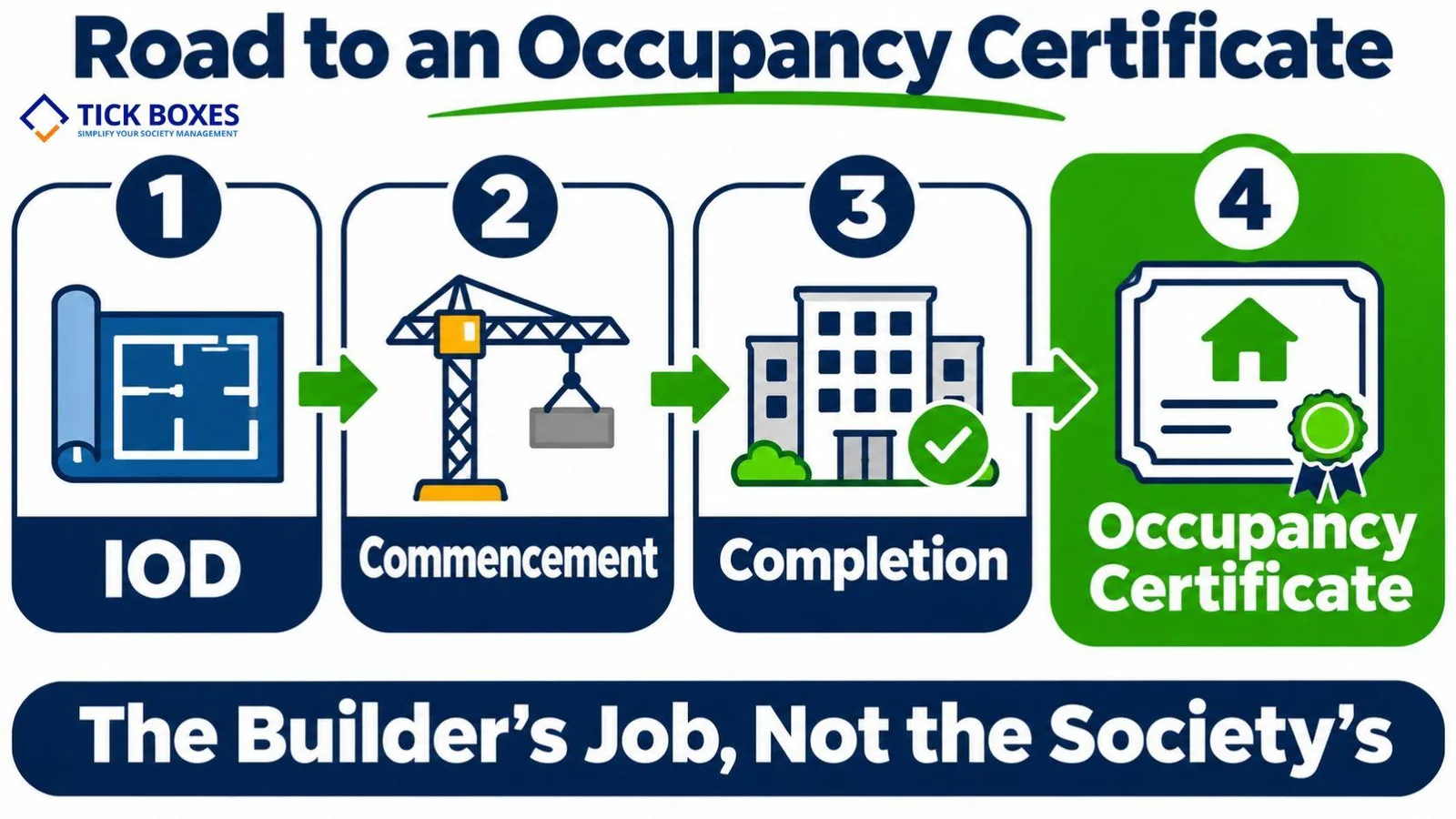
Legally, this sits with the developer, not the society. Under the Maharashtra Ownership Flats Act and Section 11(4)(b) of the RERA Act, the promoter is obligated to obtain the OC and hand it over to the society or its members.
The Supreme Court addressed a related question directly in Samruddhi Co-operative Housing Society Ltd vs Mumbai Mahalaxmi Construction Pvt Ltd (Civil Appeal No. 4000 of 2019, decided 11 January 2022).(1) The flat owners had taken possession in 1997 without an OC and were paying higher municipal taxes and water charges as a result. The society filed a consumer complaint seeking reimbursement, and the National Consumer Disputes Redressal Commission dismissed it as time-barred.
It's worth being precise about what the Supreme Court actually decided, rather than reading more into it than the judgment supports. The Court held two specific things: first, that a housing society qualifies as a "consumer" under the Consumer Protection Act; and second, that the developer's continuing failure to obtain the OC was a continuing wrong under Sections 3 and 6 of MOFA, which meant the society's complaint was not barred by limitation. The Court sent the matter back to the consumer forum to decide the compensation claim on its merits. The judgment did not lay down a general rule that a builder remains liable for every OC-related cost indefinitely; it specifically kept the door open on a limitation technicality so a society's claim for reimbursement of excess charges could be heard. The practical takeaway societies draw from it, that the obligation and exposure continue for as long as the OC stays outstanding, is a reasonable reading of the Court's reasoning, but it's a reading, not a verbatim holding, so treat it that way in any society-facing claim.
That ruling still matters for a committee chasing an old OC today. It establishes that a society isn't asking for a favour by pursuing this, and that the passage of time alone doesn't let a developer off the hook on a limitation technicality.
Can a Society Apply for the OC Itself Now?
For years, a society stuck without an OC had little recourse beyond chasing an unresponsive or long-defunct builder. That changed in 2026. BMC's General Body approved an OC Amnesty Scheme on 18 August 2026, with operating guidelines (SOP) issued on 8 September 2026, aimed at an estimated 19,000 to 20,000 buildings across the city.(2)
The scheme generally applies to flats up to 80 square metres (approximately 861 square feet) occupied between 1991 and 17 November 2016, provided the building holds a valid Intimation of Disapproval and Commencement Certificate. It's worth being upfront about where things actually stand: as of early November 2026, BMC had received around 97 registrations under the scheme, but only four applications were fully complete, with societies reporting technical issues on the AutoDCR portal slowing things down.
The practical takeaway for a committee: this is a real path forward, but an early-stage one. Confirm current eligibility and the live application process with BMC before assuming a specific building qualifies.
How to Check If Your Building Has an OC
- Visit BMC's AutoDCR portal.
- Open the citizen search section.
- Enter the ward, zone, CTS or survey number, and building name.
- Look for the OC document against the building's proposal record, and note whether it covers the full building or only part of it.
- Cross-check the wing and floor range shown against the actual building, since part OCs covering only certain towers or floors are common in phased projects.
Portal navigation on civic websites changes from time to time, so it is worth confirming the current steps directly on the portal rather than assuming last year's path still applies.
What If Your Building Has No OC?
The building can usually continue to be occupied while the gap gets sorted out, but that is not the same as the problem going away on its own. A few things actually help:
- Record the gap formally in committee minutes, so it survives committee changes rather than getting lost when volunteers rotate out.
- Put the issue in writing to the original developer, with a dated record of that communication kept on file.
- Where the builder is unresponsive, consider a MahaRERA complaint, since RERA gives allottees and societies a formal forum for exactly this kind of default.
- Check eligibility for the BMC amnesty scheme if the building falls in the 1991 to November 2016 occupation window.
- Avoid simply waiting for redevelopment to make the issue disappear. It usually just passes the same unresolved gap on to the next developer.
A Familiar Scenario
A mid-sized Mumbai society, built around 13 years ago, discovered its missing OC only when a resident's bank flagged it during a loan application. The original developer was by then difficult to reach, and the society's own paper trail was thin, since committee members had changed several times over the years without a clean handover of records.
What would have made a real difference is not a single dramatic fix, but ongoing discipline: statutory documents maintained and passed on cleanly between committees, every builder communication logged from day one, and an unresolved OC treated as a standing compliance item on the society's own radar rather than something that only surfaces when a resident runs into trouble.
A Practical OC Checklist for Managing Committees
- Confirm current OC status on BMC's AutoDCR portal and log the result, even if the answer is simply "pending."
- Locate and file any existing builder correspondence about the OC, including old or partial records.
- Record the gap formally in committee minutes if no OC exists, so the issue is not lost across committee transitions.
- Send the developer a written notice, with the date and method of that communication kept on file.
- Check eligibility under the BMC amnesty scheme if the occupation date falls in the qualifying window.
- Flag OC status explicitly in any redevelopment or deemed conveyance discussion, since it directly affects timelines and approvals.
- Treat this as a standing item in annual compliance review, not a one-time check that gets closed and forgotten.
Where Tick Boxes Fits In
An OC gap rarely gets resolved in a single meeting. It gets resolved by someone tracking it, keeping the paperwork, and following up consistently across years and committee changes, which is a difficult thing to ask of a rotating group of volunteers alongside their own jobs and lives.
This is the kind of long-running compliance item that Tick Boxes are built to carry. Backed by an in-house accounting and audit team and a dedicated on-ground society manager, Tick Boxes keeps statutory records, builder correspondence, and compliance status documented and visible year over year, not just at audit time. The committee still governs: it decides whether to pursue a MahaRERA complaint, apply under the amnesty scheme, or raise the issue during redevelopment talks. The professional management layer owns the execution underneath those decisions: tracking the status, keeping records intact, and following through so nothing depends on one volunteer's memory or one committee's tenure.
The Bottom Line
An occupancy certificate confirms a building is legally fit to live in, and getting it is the developer's job, not the society's. Its absence is rarely a one-time problem. It is a slow-burn issue that shows up in a water bill, a rejected loan application, or a stalled redevelopment conversation years after possession. BMC's 2026 amnesty scheme offers a genuine path forward for many older buildings, though it is still finding its feet.
What actually resolves this kind of issue is not a single phone call. It is steady documentation and follow-through across years, which is exactly what a professionally managed society builds into its everyday operations. For a closer look at how that works in practice, visit Tick Boxes or get in touch to discuss ongoing society management and compliance tracking for your building.
Frequently asked questions
What is an occupancy certificate in simple words?
It is a certificate from BMC confirming a building was constructed as approved and is safe to live in. Developers are required to obtain it under the RERA Act, 2016.
What is the difference between OC and CC?
In Mumbai specifically, BMC uses "CC" for Commencement Certificate, the permission to start building, not Completion Certificate as the term is often used elsewhere. The OC comes later, after construction and inspection are done.
Is an occupancy certificate mandatory in Mumbai?
Yes. RERA requires developers to obtain it before a building is occupied, although many older buildings in the city were occupied without one, which is exactly what BMC's amnesty scheme now tries to address.
How can a society check if its building has an OC?
Through BMC's AutoDCR citizen search portal, using the building's ward, zone, and CTS or survey number.
Who is responsible for getting the OC, the builder or the society?
The builder, as a legal obligation. The Supreme Court's Samruddhi ruling established that a developer can't rely on the passage of time to escape a society's claim over unresolved OC-related charges, so a society pursuing it is enforcing the builder's duty, not covering for its own gap.
 Redevelopment of Housing Societies in Mumbai: The Step-by-Step Process Under the 2026 Rules
 What Is a Conveyance Deed, and Why Does Your Housing Society Need One?
 Deemed Conveyance in Mumbai: How Your Society Gets Title When the Builder Won't