

Quick answer: A conveyance deed is the registered document that transfers ownership of land and a building from the developer to the housing society. Without it, the society doesn't legally own the ground it stands on, which blocks redevelopment, loans against the property, and clean property records.
Key points at a glance:
- The builder must execute it within four months of the society's registration.
- If the builder doesn't, the society can apply for a "deemed conveyance" through the District Deputy Registrar, which carries the same legal weight.
- A 2025 amendment extended this deemed conveyance route to RERA-registered projects too.
- Without conveyance, redevelopment and mortgage approvals get stuck.
- Stamp duty on the final conveyance is usually nominal if duty was already paid on the original flat agreements.
In this article
- The gap that only shows up when it's too late
- What is a conveyance deed?
- What does it actually transfer to society?
- Who has to execute it, and by when?
- What happens if the builder never does it?
- Does RERA change anything here?
- Conveyance deed vs. sale deed: what's actually different
- What does a conveyance deed actually contain?
- What stamp duty applies at this stage?
- A real situation: what this looks like when it's ignored
- A quick checklist for committees
- Why this is a management problem, not just a legal one
- Other documents worth checking alongside the conveyance deed
- The bottom line
- Frequently asked questions
The gap that only shows up when it's too late
Most housing societies in Mumbai don't think about their conveyance deed until it becomes a problem. A bank asks for it before approving a loan against the building. A developer asks for it before starting redevelopment talks. A buyer's lawyer asks for it during due diligence. And that's usually the first time anyone on the committee realises the document might not exist.
A conveyance deed is what legally transfers ownership of the land and the building, from the builder to the society, as a collective entity. Individual flat owners already hold title to their own flats through their sale agreements. What's missing, in a lot of older buildings, is the society's own title to the land and structure it sits on.
Under the Maharashtra Ownership Flats Act (MOFA), the builder has a legal deadline to hand this over. Many simply never do. This guide walks through what the deed actually covers, what that deadline is, what happens when builders miss it, and what a committee should actually check before this becomes urgent.(1)
What is a conveyance deed?
A conveyance deed is a registered legal document that transfers ownership rights in a property from one party to another. It's a broad legal term. It covers sales, but also gifts, exchanges, mortgages and leases.
For a housing society, the relevant type is the conveyance of land and building from the original landowner or developer to the society as a legal body. This is different from the sale agreement each flat owner signed when buying their flat. That agreement creates a right to the flat. It doesn't, by itself, transfer legal title to the land underneath the building.
Until the conveyance deed is registered, legal ownership of that land can still sit with the builder, even years after every flat has been sold and families have moved in.
What does it actually transfer to society?
A conveyance deed transfers the land, the building structure, and the common areas, not just the individual flats. Flat ownership already exists separately, through each owner's registered sale agreement.
This matters because it's the society, not any individual member, that needs to be recorded as the legal owner of the property for things like redevelopment approvals, loans taken against the building, or legal disputes involving the land itself. Section 11(1) of MOFA spells out this obligation directly: the promoter must convey their right, title and interest in the land and building to the cooperative housing society.(2)
Who has to execute it, and by when?
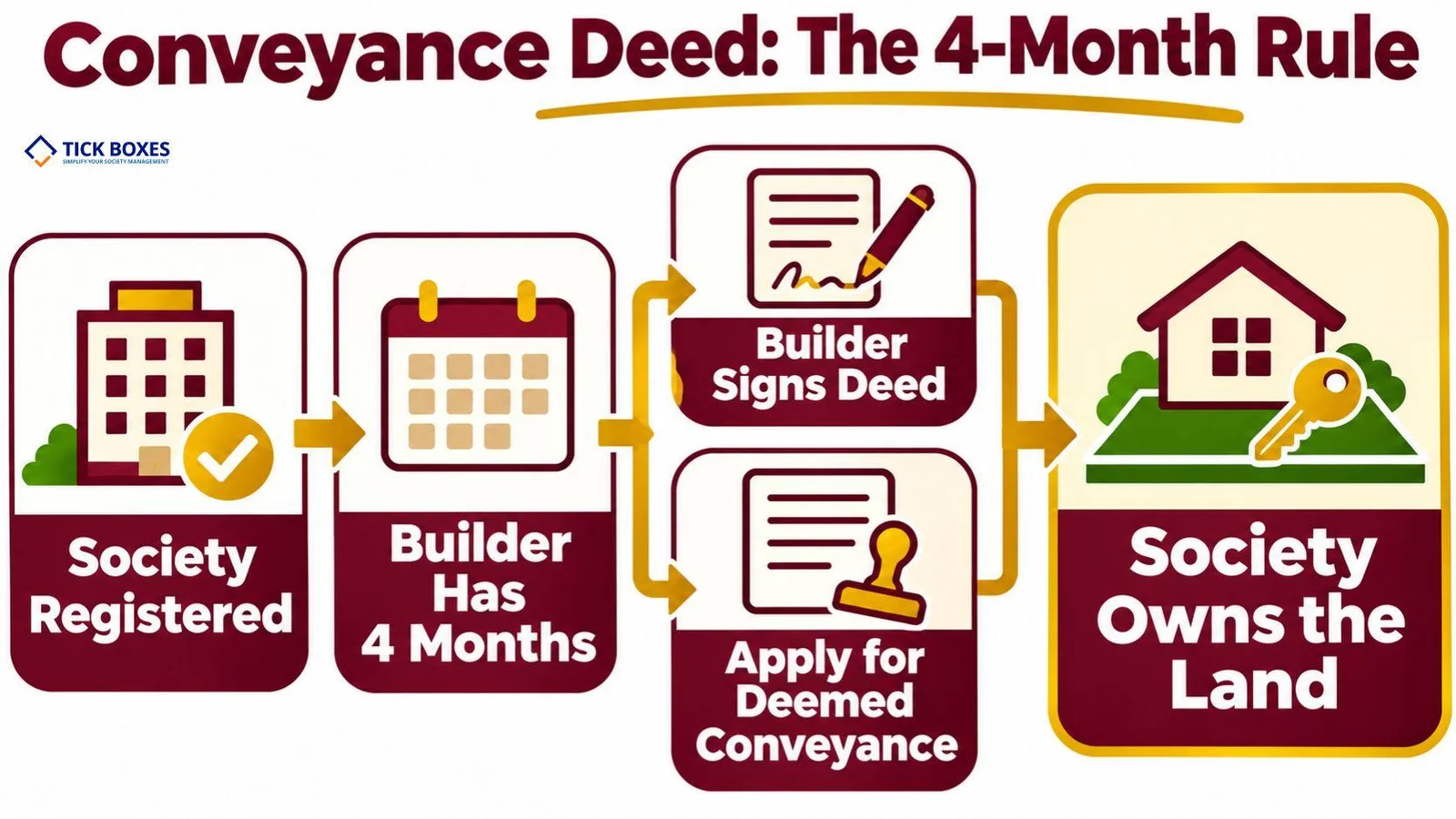
The builder, or promoter, is legally required to execute the conveyance deed within four months of the society's registration. This isn't a vague guideline. It's set out in Rule 9 of the MOFA Rules, 1964, read together with Section 11(1) of the Act itself, and Bombay High Court rulings have repeatedly confirmed this four-month window as a firm statutory deadline, not something a builder can push back through a side agreement or delayed construction.(3)
The clock starts from the date the society is registered, not from possession, not from when the last flat is sold. A lot of societies only check this years later, once the deadline has long passed and the builder has moved on to other projects.
What happens if the builder never does it?
If the four months pass with no conveyance deed, the society has a legal remedy: applying for what's called a deemed conveyance, through the Competent Authority, which in practice is the District Deputy Registrar of Co-operative Societies.
A deemed conveyance order carries the same legal weight as a deed the builder signs voluntarily. The difference is only in how the title gets transferred, not in the outcome.
To apply, the society typically needs its registration certificate, member share certificates, the general body resolution authorising the application, sale agreements, and approved building plans. The Competent Authority examines these documents and, where the case is clear, issues an order directing the registration of the deed, without needing the builder's cooperation.
This process has its own details, from filing the application to getting the final registered copy. We've covered that step by step in a separate post on applying for deemed conveyance in Mumbai societies, which is worth reading in full if your society is in this position.
Does RERA change anything here?
Until recently, there was real uncertainty about whether this deemed conveyance route applied to buildings registered under RERA, which came into force in 2016. MOFA's deemed conveyance mechanism predates RERA, and it wasn't clear whether societies in newer, RERA-registered projects could use it at all.
The Maharashtra Ownership Flats (Amendment and Validation) Act, 2025, enacted in December 2025, resolved this by inserting a new Section 11A into MOFA. This section specifically lets allottees and societies in RERA-registered projects apply for deemed conveyance through the same Competent Authority process under MOFA, where the promoter has failed to execute conveyance under RERA's own Section 17.(4) The amendment applies retrospectively from May 2016, which closes a gap that had existed for close to a decade.
In short: if your society assumed it had no deemed conveyance option because the building was registered after 2016, that's no longer accurate.
Conveyance deed vs. sale deed: what's actually different
These two terms get used interchangeably, but they aren't quite the same thing. A sale deed is one specific type of conveyance deed, used only where a property is being sold for consideration. Conveyance deed is the broader category.
| Aspect | Conveyance Deed | Sale Deed |
|---|---|---|
| Scope | Covers any transfer of ownership: sale, gift, exchange, mortgage or lease | Covers only a sale transaction |
| Use for a society | Transfers land and building from builder to the society | Transfers an individual flat from one owner to another |
| Consideration | Not always required (a gift deed, for instance, involves none) | Always requires monetary consideration |
| Governing law | Transfer of Property Act, 1882 and Registration Act, 1908; MOFA Section 11 for societies specifically | Transfer of Property Act, 1882 and Registration Act, 1908 |
Put simply: every sale deed is a type of conveyance deed, but not every conveyance deed is a sale deed. For a housing society, the document you're chasing from the builder is a conveyance deed in the broader sense, since it's transferring land and a building to a collective body, not completing a sale to one buyer.
What does a conveyance deed actually contain?
Rather than a fill-in-the-blank form, think of it as a structured legal document covering a few essentials: full details of both parties (the promoter and the society), a complete description of the property being transferred, the specific rights and interests being conveyed, any existing encumbrances on the land, and the registration particulars once it's executed at the Sub-Registrar's office.
This is also why document readiness matters so much before a society even starts the deemed conveyance process. Share certificates, sale agreements and building plans need to be complete and accessible, not scattered across old committee members' personal files.
What stamp duty applies at this stage?
Stamp duty is usually the part that worries committees most, and it's often less than expected. If stamp duty was already paid when the original flat sale agreements were registered, the final conveyance deed typically attracts only a nominal stamp duty of around ₹100 per flat, under a specific provision in the Maharashtra Stamp Act. The logic is simple: the state doesn't charge full duty twice on the same underlying transaction.(5)
This is different from the regular stamp duty rate on a fresh conveyance, which runs to 6% in Mumbai for most buyers. That full rate applies to new transactions, not to a society finally formalising conveyance on flats where duty was already paid years ago. It's worth getting this confirmed for your specific building, since the applicable rate depends on when the original agreements were stamped and registered.
A real situation: what this looks like when it's ignored
Take a 32-unit society in Chembur, built in 2011. After years of aging plumbing and one too many monsoon leaks, the committee starts exploring self-redevelopment. They approach a bank for financing and a developer for a proposal. Both ask for the registered conveyance deed.
Nobody currently on the committee was around when the building was handed over. Nobody can immediately say whether a conveyance deed exists, let alone produce a copy. What follows is weeks of digging through old files, a visit to the Sub-Registrar's office to check if anything was ever registered, and the uncomfortable discovery that share certificates are all in order, but the conveyance itself was never done.
Self-redevelopment specifically depends on clear title, so the whole plan stalls while the committee starts a deemed conveyance application from scratch, months after they'd hoped to be breaking ground.
This isn't a story about a careless committee. It's what happens when a document like this sits outside anyone's ongoing responsibility, and only gets noticed once something else depends on it.
A quick checklist for committees

A few things worth checking now, rather than waiting for a bank or developer to ask:
- Locate the deed. Ask whether a registered conveyance deed exists on file, and if not, check with the Sub-Registrar for any record.
- Check the timeline. If the society was registered more than four months ago with no conveyance executed, the builder is already in default.
- Identify the project type. Whether the building is pre-RERA or RERA-registered decides whether the standard Section 11(3) route or the newer Section 11A route applies.
- Get documents in order. Registration certificate, member list, sale agreements and building plans should be assembled well before they're urgently needed.
- Make the call as a committee. Whether to approach the builder directly or file for deemed conveyance should go through a general body resolution, not stay informal.
- Secure the original once registered. Keep certified copies for day-to-day reference, the original in safe storage, and an Index II copy easily accessible.
Why this is a management problem, not just a legal one
The Chembur example isn't really about one missing document. It's about what happens when nobody owns tracking something like this over years of changing committees, misplaced minutes, and files that move from one member's cupboard to another's laptop.
A society can be fully compliant at audit time and still not hold clear legal title to its own land, because those are two different things. Audit compliance checks the books. It doesn't check whether a building's conveyance was ever executed.
This is where professional society management earns its place. A dedicated society manager tracks statutory records as an ongoing responsibility, not a once-a-year scramble, and flags a gap like a missing conveyance deed long before a redevelopment conversation or a bank's loan officer forces the question. The committee still makes the call on whether to pursue the builder or file for deemed conveyance. What changes is that the information needed to make that call, and the follow-through once it's made, doesn't rest on which committee member happens to remember where the old files went.
Tick Boxes works this way for societies across Mumbai: hands-on management, backed by an in-house accounting and audit team, so statutory documentation stays current year-round instead of being reconstructed under pressure.
Other documents worth checking alongside the conveyance deed
A conveyance deed rarely stands alone. Societies should also hold:
- The Occupancy Certificate (OC), which confirms the building was constructed as per sanctioned plans and is fit for occupation.
- An Index II copy, the official proof that the deed was actually registered at the Sub-Registrar's office.
- Building plans and approvals, which both the deemed conveyance process and any future redevelopment will ask for.
Keeping these together, rather than scattered, saves real time whenever the society needs to prove its standing, whether that's for a loan, a redevelopment proposal, or a sale.
The bottom line
A conveyance deed isn't paperwork for its own sake. It's the document that settles who actually owns the ground a building stands on. Most societies don't think about it until something else, a loan, a sale, a redevelopment plan, forces the question. By then, it's a bigger problem than it needed to be.
The better approach is treating this as something worth checking quietly, year after year, as part of how a society is run, not something to rediscover in a crunch. If your committee isn't sure where your society stands on this, Tick Boxes' society management team can help you find out, and keep it from becoming a surprise again.
Frequently asked questions
What is a conveyance deed in simple words?
It's the legal document that transfers ownership of a property from one party to another. For a housing society, it specifically transfers the land and building from the builder to the society as a collective body.
Is a conveyance deed mandatory for a housing society in Mumbai?
Yes. MOFA places a statutory duty on the builder to execute it within four months of the society's registration. The deemed conveyance mechanism exists precisely because so many builders miss this deadline.
Who pays for the conveyance deed?
Stamp duty and registration costs are generally handled as per the terms agreed at the time of the original flat sale agreements. If duty was already paid then, only a nominal amount typically applies at the conveyance stage itself.
How long does a builder have to give the conveyance deed?
Four months from the date the housing society is registered, as set out under Rule 9 of the MOFA Rules, 1964.
What's the difference between a conveyance deed and a sale deed?
A sale deed is one type of conveyance deed, used specifically where a property changes hands through a sale. Conveyance deed is the wider category, also covering gifts, exchanges, mortgages and leases.
Can a society redevelop without a conveyance deed?
In practice, redevelopment, including self-redevelopment, depends on the society holding clear legal title. This is one of the main reasons societies pursue deemed conveyance: to unlock a redevelopment process that would otherwise stall.
Sources
- https://rawlaw.in/bombay-high-court-conveyance-is-a-statutory-right-not-a-charity-court-upholds-unilateral-deemed-conveyance-in-favour-of-co-operative-housing-society/
- https://api.sci.gov.in/jonew/bosir/orderpdf/1149278.pdf
- https://api.sci.gov.in/supremecourt/2018/17307/17307_2018_4_1502_61073_Judgement_21-Apr-2025.pdf
- https://bombayhighcourt.gov.in/bhc/libweb/legislation/acts/Stateact/2025acts/2025.65.pdf
- https://www.taxmann.com/post/blog/all-about-maharashtra-stamp-duty-amnesty-scheme
 Deemed Conveyance in Mumbai: How Your Society Gets Title When the Builder Won't
 Nomination in a Housing Society: Who Can Be a Nominee, and What It Does Not Do
 Occupancy Certificate in Mumbai: What It Means and Why Your Society Needs One