

Quick answer: Redevelopment of a Mumbai housing society moves through fixed stages: confirming title and building condition, member consent of at least 51% of total membership, a Project Report, public tendering for a developer (or self-redevelopment), approvals, vacating, construction and possession. A revised Government Resolution dated 30 September 2026 now governs this entire process, replacing the framework that had been in place since 2019.
Key points at a glance:
- Only a duly elected Managing Committee can run redevelopment; an administrator or authorised officer cannot initiate it.
- Developer appointment needs written approval from at least 51% of total membership, not just those present at a meeting.
- The 2026 rules introduce firm deadlines: 30 days for the Project Report meeting, 14 days for the Registrar's decision on an Authorised Officer, and 3 months for the Permanent Alternative Accommodation Agreement.
- Self-redevelopment is available once a building is at least 30 years old, with the society itself acting as developer.
- There's no fixed legal timeline for the full project, though two to three years is a commonly cited range when things go smoothly.
In this article
- Redevelopment in Mumbai: From a society discussion to a formal process
- Before you start: what your society needs to check first
- Who can actually run the redevelopment process?
- Step by step: the redevelopment process under the current rules
- How is member consent actually counted?
- Developer-led vs. self-redevelopment: what's actually different
- What happens to society funds during redevelopment
- How long does redevelopment actually take?
- Common mistakes committees make
- A practical readiness checklist
- Why this is a continuity problem, not just a legal one
- Conclusion
- Frequently asked questions
Redevelopment in Mumbai: From a society discussion to a formal process
Redevelopment often begins with a simple question: Is it time for the society to rebuild? For many ageing housing societies in Mumbai, the answer comes after years of maintenance issues, rising repair costs and concerns about structural safety. But deciding to redevelop is only the first step. The society must also understand the legal procedures, member approvals, committee responsibilities and regulatory requirements involved.
Recent changes to Maharashtra's redevelopment framework have also made it important for housing societies to understand what the process looks like today.
Before you start: what your society needs to check first
Before any redevelopment conversation gets serious, a few things need confirming: that the society holds clear title through a conveyance deed or deemed conveyance, that the Occupation Certificate position is understood, that a current structural audit exists, and that share certificates and member records are complete and up to date.
We've covered conveyance and deemed conveyance in detail in earlier posts, since this is one of the most common things that stalls a redevelopment proposal before it even gets to the consent stage. A developer or lender evaluating the project will ask for clear title early, and gaps here are far cheaper to fix before negotiations start than during them.
Who can actually run the redevelopment process?
This is one of the clearest changes in the current rules. Redevelopment must be undertaken only by a duly elected and lawfully constituted Managing Committee. An Authorised Officer, Administrator, or Board of Authorised Officers appointed by the Registrar cannot take the decision to redevelop on the society's behalf.(1)
This directly closes a gap that existed under the earlier framework, where redevelopment was sometimes being driven by committees whose tenure had expired or that hadn't been properly elected in the first place.
Step by step: the redevelopment process under the current rules
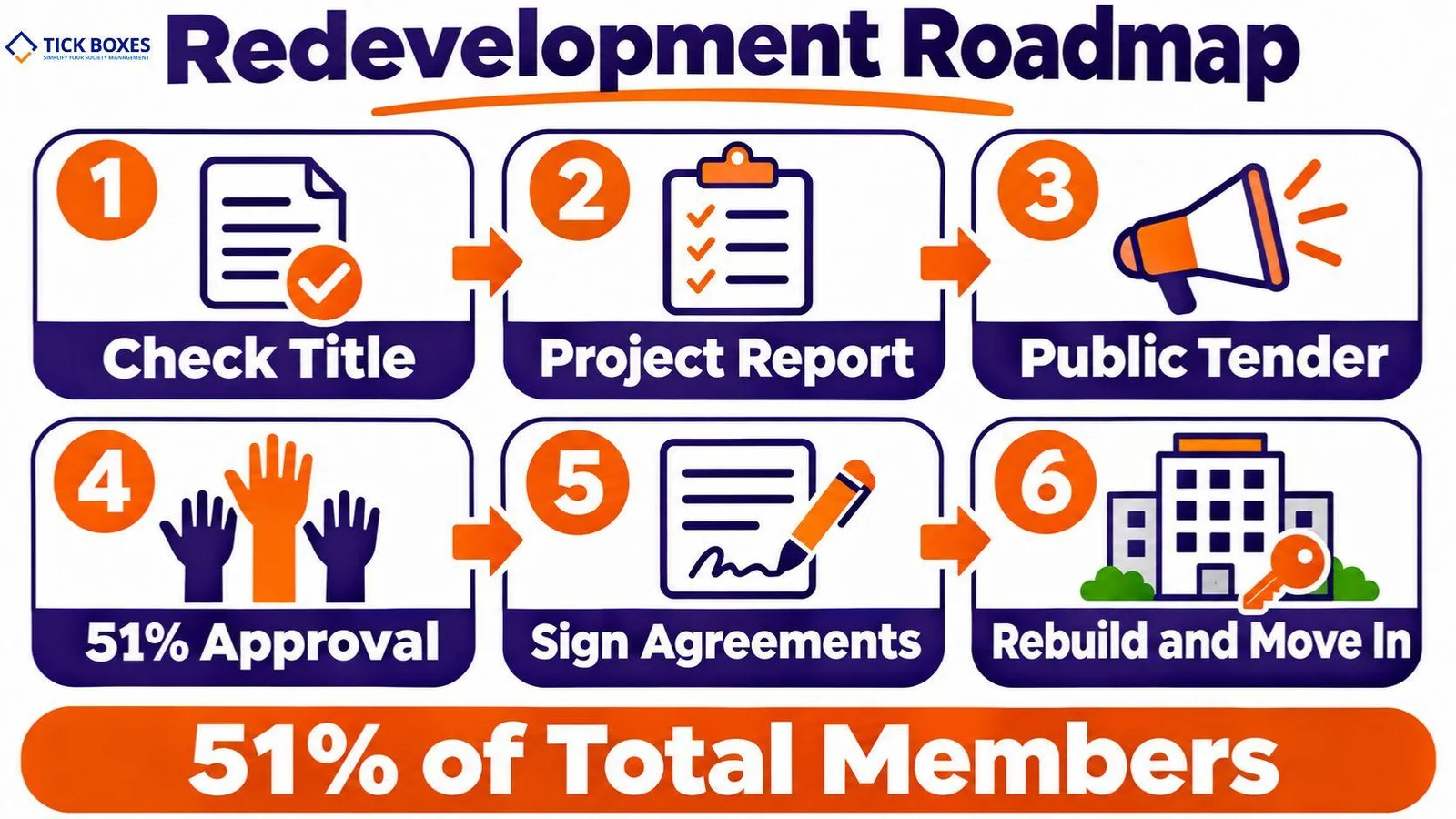
The process runs through a defined sequence, with firmer timelines at several stages than before:
- At least one-fifth of members can formally request a Special General Meeting to raise redevelopment, submitting plans and suggestions in writing. The committee must record the request within 8 days and convene the meeting within 2 months.
- A structural audit and feasibility assessment is commissioned.
- A Project Report is prepared. The Secretary must convene a Managing Committee meeting within 30 days of receiving it, and members can inspect the report and submit suggestions at least 7 days before that meeting.
- A draft tender is prepared and placed before a Special General Body Meeting for approval.
- Public tenders are invited through notices in Marathi and English newspapers with wide local circulation, with members also able to suggest reputed developers.
- Tenders are opened at the Special General Body Meeting, held within 30 days of the tender deadline, with defined extension periods if fewer than three tenders come in.
- The Managing Committee submits the SGBM minutes, member list, Project Report and tender details to the Registrar for appointment of an Authorised Officer, who must decide within 14 days.
- Developer appointment requires written approval from at least 51% of total membership, obtained from members present physically or through video conferencing, with a secret ballot option available if a fifth of members request one.
- The Development Agreement and the Permanent Alternative Accommodation Agreement (PAAA) are registered, with the PAAA now required within 3 months of the Development Agreement's registration.
- Members vacate, and construction proceeds.
- On completion, flat and shop allotment goes through a Special General Body Meeting with at least 14 days' notice, video-recorded, with results filed with the Registrar within a month. New flat and shop holders' membership applications must then be processed within 3 months of possession.
This is a meaningfully more structured sequence than societies were working with even a year ago, and it's worth checking the full text of the current Government Resolution directly for any procedural detail that affects your specific situation, since secondary summaries, including this one, can miss nuance.
How is member consent actually counted?
This trips up a lot of committees. Developer appointment needs written approval from at least 51% of a society's total membership, not 51% of whoever happens to show up at the meeting.(2)
Here's how it works in practice: in a 100-member society, a two-thirds quorum means 67 members need to attend, in person or by video conference. Of the society's full membership, at least 51 must approve, regardless of whether 67 or 75 members actually attended. Video conferencing now counts toward both quorum and approval, but at least 51% of the total membership must still be physically present. An absent member's vote simply doesn't count, however they feel about the proposal.
This is a meaningful tightening from where things stood even a few years ago. A separate 2022 amendment had already reduced the consent threshold for redevelopment of dangerous buildings from 70% to 51%, and the current framework builds on that lower threshold while making the counting method far more precise.(3)
Developer-led vs. self-redevelopment: what's actually different
| Aspect | Developer-Led Redevelopment | Self-Redevelopment |
|---|---|---|
| Who acts as developer | A private builder | The society itself |
| Financing | Developer arranges funds | Society arranges financing, usually via co-operative bank loans |
| Control over decisions | Shared with, or largely led by, the developer | Retained fully by the society |
| Where sale-flat profit goes | Kept by the developer | Remains with the society and members |
| Eligibility | Any society with clear title | Building must be at least 30 years old |
| Risk | Depends on the developer's track record and financial stability | Borne directly by the society, usually with professional consultants |
Self-redevelopment has gained real traction in Mumbai over the past several years, partly out of frustration with delayed developer-led projects. The scheme requires the building to be at least 30 years old, with MHADA historically acting as a facilitating authority for the various permissions involved, regardless of who owns the underlying land.
It isn't automatically the better option. Societies that go this route take on genuinely developer-like responsibilities, from arranging finance to managing contractors directly, which is a significant shift in workload and risk for a volunteer committee, even with professional consultants supporting the process.
What happens to society funds during redevelopment
Accumulated sinking fund and repair fund money stays the society's collective property throughout redevelopment, not the developer's. It's typically moved into a designated project account, or used to clear pending dues and settle liabilities, with any such allocation requiring prior General Body approval and proper minuting. Post-redevelopment, this money is usually refunded, adjusted, or rolled into the new society's corpus, depending on the terms agreed at the time.
This is worth getting right on paper early. Fund handling questions that aren't resolved through a clear resolution tend to resurface as disputes later, once the project is already underway.
How long does redevelopment actually take?
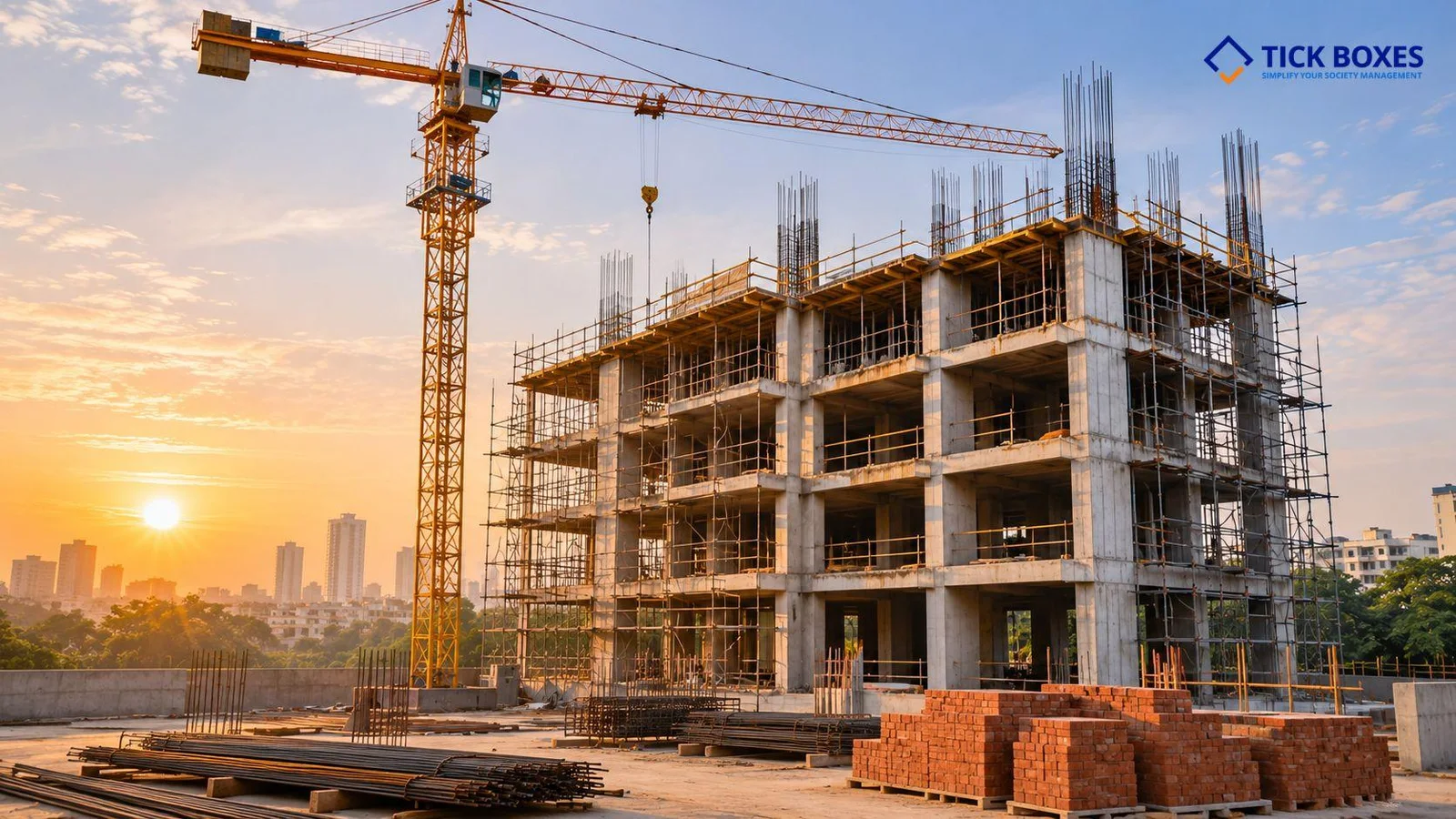
There's no fixed legal deadline for a redevelopment project overall, and it's worth being honest about that rather than quoting a precise figure as fact. Industry sources commonly describe redevelopment as ideally completing within two years, extending to three years in more complicated cases, with delays typically compensated through additional rent to displaced residents.
Self-redevelopment projects have, in some documented cases, moved faster than this. Charkop Jin Prem Cooperative Housing Society in Kandivali completed its self-funded redevelopment in two years, though outcomes like this depend heavily on how well-organised and well-financed the specific project is, not a general guarantee of the self-redevelopment route.(4)
What the current rules do set firmly are specific sub-timelines within the process, the 30-day Project Report meeting, the 14-day Registrar decision, the 3-month PAAA deadline, rather than a deadline for the project as a whole.
Common mistakes committees make
A few recurring patterns, each tied to something the current rules now specifically address:
- Starting the process without confirming the title first. Conveyance or deemed conveyance gaps surface at the worst possible moment, mid-negotiation with a developer or lender.
- Letting an improperly constituted committee drive the decision. This is now explicitly barred.
- Treating developer selection as informal. Public tendering, documented comparison of bids, and a 51%-of-total-membership vote are all now required steps, not best practices.
- Not keeping documents accessible. Meeting minutes, video recordings, consultant reports, tender documents and the draft Development Agreement must now be available for member inspection.
- Assuming the bank guarantee is fixed at 20%. That figure is no longer prescribed; it's now a General Body negotiation.
A practical readiness checklist
- Confirm title first. Conveyance or deemed conveyance should be settled, or actively in progress, before serious redevelopment discussion begins.
- Get a current structural audit. This is usually the real trigger and the evidentiary basis for the eventual decision.
- Confirm committee legitimacy. Only a duly elected, current Managing Committee can run this process.
- Track every statutory deadline. The 30-day, 14-day and 3-month windows are enforceable timelines now, not informal guidance.
- Keep documents open for inspection. This is now an express obligation, not a courtesy.
- Document consent properly. Written approval from 51% of total membership, counted correctly, with a secret ballot option on request.
- Decide developer-led vs. self-redevelopment deliberately. This is a financing and risk decision, not a default.
- Plan fund handling in advance. Get a clear General Body resolution on sinking and repair fund allocation before the project starts.
- Keep post-possession records ready. New members' certificates need processing within 3 months of handover.
Why this is a continuity problem, not just a legal one
A redevelopment project routinely outlasts a single committee's term. The rules now in force give societies a far clearer structure to follow than before, with real deadlines and documented accountability at each stage. But that structure only helps if someone is actually tracking it consistently, through committee changeovers, through multiple hearings and meetings, and across what can be a multi-year timeline.
This is where professional society management earns its place. A dedicated society manager tracks the Project Report deadline, the Registrar's 14-day window, the PAAA's 3-month clock, and keeps documentation accessible to members throughout, rather than these things depending on whichever committee happens to be in office at any given stage. The committee still makes every governance call: approving the Project Report, voting on developer selection, deciding how funds get handled. What changes is that the deadlines, documentation and member communication the current rules now require don't quietly lapse between committee terms.
Conclusion
Redevelopment has always been one of the biggest decisions a housing society makes. What's changed is that the process now has considerably more structure, firmer deadlines, and clearer accountability than it did even a year ago. That's genuinely good news for members. It also means more for a committee to track correctly, across a process that will likely span more than one committee's term.
If your society is approaching this decision and isn't sure where to start, or is already partway through and struggling to keep the documentation and deadlines straight, Tick Boxes' society management team can help carry that process through properly, from the first structural audit to the last share certificate.
Frequently asked questions
What is the redevelopment process for a housing society in Mumbai?
It runs through confirming title and structural condition, member consent of at least 51% of total membership, a Project Report, public tendering for a developer or a self-redevelopment decision, approvals, vacating, construction, and finally possession and new member registration.
How many members must agree to redevelopment?
Developer appointment needs written approval from at least 51% of a society's total membership, not 51% of those merely present at a meeting. Video-conference participation counts toward this, provided at least 51% of total membership attends physically.
Do we need a conveyance deed before redevelopment?
Practically, yes. Clear title is something developers and lenders expect to see early, and deemed conveyance exists specifically for societies where the builder never conveyed the land in the first place.
What is self-redevelopment?
A model where the society itself takes on the developer's role, available once a building is at least 30 years old. It gives the society more control and retains any sale-flat profit within the society, but also means taking on financing and execution risk directly.
How long does redevelopment take?
There's no fixed legal deadline for the overall project. A commonly cited range is around two years under favourable conditions, extending to three or more where delays occur. Specific stages within the process do not carry firm, enforceable deadlines.
What happens to members during construction?
Members typically vacate to transit accommodation or receive rent compensation, under terms set out in the Permanent Alternative Accommodation Agreement, which must now be executed within 3 months of the Development Agreement's registration.
Sources
- https://www.constructionworld.in/latest-construction-news/real-estate-news/maharashtra-tightens-housing-society-redevelopment-rules/98248
- https://www.legal500.com/intelligence/india/real-estate-and-construction/members-first-maharashtra-recasts-society-redevelopment
- https://www.legal500.com/intelligence/india/real-estate-and-construction/mumbai-redevelopment-2024-legal-guide-for-builders-chs-and-developers
- https://timesofindia.indiatimes.com/city/mumbai/charkop-building-to-serve-as-case-study-for-self-redevpt/articleshow/73560240.cms
 What Is a Conveyance Deed, and Why Does Your Housing Society Need One?
 Deemed Conveyance in Mumbai: How Your Society Gets Title When the Builder Won't
 Nomination in a Housing Society: Who Can Be a Nominee, and What It Does Not Do