
Quick answer: Deemed conveyance is the legal route a Mumbai housing society uses to get ownership of its land and building when the builder has failed to execute a conveyance deed. The District Deputy Registrar, acting as Competent Authority under MOFA, can issue an order with the same legal effect as a deed the builder signs voluntarily.
Key points at a glance:
- Any society registered under the Maharashtra Co-operative Societies Act can apply once the builder's conveyance deadline has passed.
- The application goes in on Form VII to the District Deputy Registrar, with a ₹2,000 court fee.
- Applications now run through a digital portal, PRATYAY MahaBhumi, though some societies have hit technical snags since launch.
- The process is designed to conclude within six months, though real timelines vary by district and case.
- Registering the final deed usually attracts only a nominal fee if stamp duty was already paid on the original flat sale agreements.
In this article
- A Mumbai scenario that's more common than it should be
- What is deemed conveyance, exactly?
- Who can actually apply?
- Step by step: how the procedure actually works
- What's changed with the PRATYAY MahaBhumi portal
- What documents does a society actually need?
- What does deemed conveyance actually cost?
- Deemed conveyance vs. a regular conveyance deed
- Where Mumbai societies commonly get stuck
- When does a society need professional help with this?
- How Professional Society Management Supports the Deemed Conveyance Process
- A practical checklist for committees
- Why this is a continuity problem as much as a legal one
- The Final Thought
- Frequently asked questions
A Mumbai scenario that's more common than it should be
A society in a Mumbai suburb, registered in the late 1990s, has around 40 flats and a committee that changes every couple of years. The original builder wound down operations long ago and is effectively unreachable now. For two decades, nobody chased the conveyance, because nothing forced the question.
Then residents start pushing for redevelopment, given the building's age. The developer evaluating the project asks for a clear title before committing to anything. The committee discovers there's no registered conveyance deed, no clear record of who the original landowner even was, and a few Index II copies missing for flats that changed hands years ago.
This is exactly the situation deemed conveyance exists for. Our guide to the conveyance deed explains what a conveyance deed actually is and why societies need one in the first place. This piece covers what happens when the builder never gives it, and what a society has to do about it.
What is deemed conveyance, exactly?
Deemed conveyance is a legal mechanism under Section 11(3) of the Maharashtra Ownership Flats Act (MOFA) that lets a society obtain an order from a Competent Authority, transferring title to the land and building, when the builder has defaulted on executing a voluntary conveyance.
The legal outcome is the same as a regular conveyance deed: the society ends up as the registered owner. The route to get there is different. Instead of the builder signing a deed voluntarily, the society applies, the Competent Authority examines the documents and hears both sides, and then issues an order directing registration.(1)
It's worth being clear about one thing: a deemed conveyance order isn't a lesser or provisional form of ownership. Once registered, it carries the same legal standing as a conveyance deed the builder executed himself.
Who can actually apply?
Any housing society, or company or association of flat purchasers, registered under the Maharashtra Co-operative Societies Act can apply, provided the builder's statutory conveyance period has run out without the deed being executed.
That's the entire eligibility test. Societies don't need to prove the builder acted in bad faith, or go through some separate dispute process first. Once the four-month window under Rule 9 of the MOFA Rules has lapsed, the society's right to apply is triggered, regardless of why the builder hasn't conveyed.(2)
Step by step: how the procedure actually works
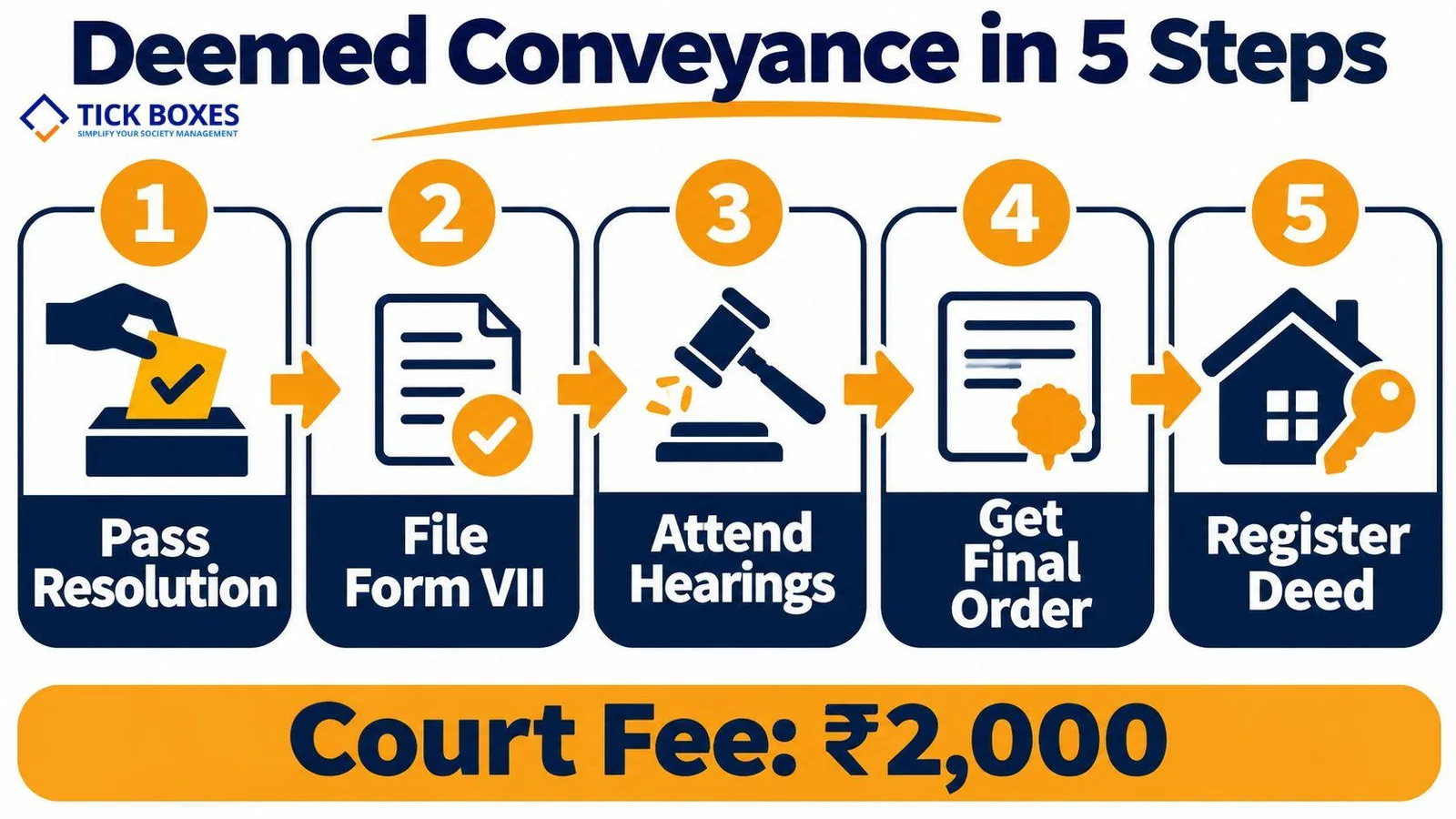
The process runs through several distinct stages, not a single filing-to-approval step:
- The society passes a general body resolution authorising the application.
- The application is filed on Form VII with the District Deputy Registrar, along with the required court fee.
- The Competent Authority issues notice to the builder and landowner, and schedules hearings.
- The society presents its documents; the authority reviews title records, building approvals and the draft deed.
- A draft conveyance deed is presented for the Competent Authority's approval, typically across a few hearings rather than one.
- A final order is issued, directing registration.
- Stamp duty gets adjudicated, and the deed is registered at the Sub-Registrar's office.
Real-world timelines vary a lot depending on the district office's workload and whether the builder responds at all. Some cases move through in a few months; others take longer, particularly where title records are incomplete or disputed. It's worth treating any quoted timeline as a general expectation, not a guarantee.
What's changed with the PRATYAY MahaBhumi portal
In May 2025, Maharashtra's cooperation department launched a digital portal, PRATYAY MahaBhumi, letting societies apply for deemed conveyance online instead of filing paper applications at the registrar's office. The stated goal was to cut down on physical visits and bring hearing schedules and case updates online, with a six-month target for the whole process.(3)
It's worth noting this honestly: the rollout hasn't been entirely smooth. Several societies in Mumbai and Pune reported login failures and incomplete submissions in the months after launch, and some reverted to offline applications while the issues were being sorted out. If your society is filing now, it's worth checking directly with your district registrar's office on whether online filing is working smoothly before committing to it as the only route.
What documents does a society actually need?

The application needs a fairly specific document set alongside Form VII:
- Society registration certificate and bye-laws
- General body resolution authorising the application
- List of members in the prescribed format
- Copies of registered sale agreements and Index II for each member
- A draft conveyance deed
- Approved building plans
- Occupation Certificate, where available (not always mandatory)
- Property tax payment proof
- A location plan of the building
Most of the delay societies run into isn't legal complexity. It's gaps in this list, particularly Index II copies for flats that changed hands years ago, or a member list that hasn't been updated to reflect actual current owners.
What does deemed conveyance actually cost?
There are really two separate costs here, and it helps to keep them apart.
The first is the application itself: a court fee stamp of ₹2,000 accompanies Form VII, on top of which most societies also budget for advocate fees, since drafting the application and representing the society at hearings usually needs legal support.(4)
The second, separate cost is stamp duty on the final registered deed. This is where societies often overestimate what they'll owe. If stamp duty was already paid when individual members registered their original flat sale agreements, the deemed conveyance deed itself typically attracts only a nominal registration fee, rather than full duty being charged a second time on the same underlying transaction.
For a reasonably sized society, the court fee alone works out to a small amount per flat. The bigger, more variable cost is usually legal support through the hearings, not the government fees.
Deemed conveyance vs. a regular conveyance deed
| Aspect | Conveyance Deed | Deemed Conveyance |
|---|---|---|
| Who executes it | The builder, voluntarily | The Competent Authority, by order |
| What triggers it | Builder complies within the statutory period | Builder defaults past that deadline |
| Process | Direct execution and registration between parties | Application, hearings, authority order, then registration |
| Builder's cooperation needed | Yes | No, that's the point of the mechanism |
In practice, deemed conveyance exists specifically to remove the builder as a bottleneck. A society doesn't need the builder's signature, participation, or even cooperation for the process to conclude.
Where Mumbai societies commonly get stuck
The most common friction points aren't really about the law itself. They're about readiness. Societies that can't quickly produce a complete member list, full Index II copies, or a clear building plan tend to lose months just assembling paperwork before a hearing can meaningfully proceed.
The other recurring issue is a builder who actively contests the application, disputing boundaries or claiming unresolved dues from individual members. The Competent Authority can still proceed in most such cases, but contested applications naturally take longer than uncontested ones.
And then there's the simplest problem of all: societies that don't realise their four-month window closed years ago, because nobody has been tracking it. By the time redevelopment or a loan forces the question, the gap has often existed for a decade or more.
When does a society need professional help with this?
Given the hearings, the document compilation, and the coordination with the registrar's office, most societies get through this faster and with less friction when someone is managing the process end to end, rather than leaving it to whichever committee member has spare time between their day job and the rest of their committee duties.
This is also where continuity matters more than people expect. Committees change every two or three years. A deemed conveyance application can run longer than a single committee's term. Without someone tracking hearing dates and document status independently of who's currently on the committee, institutional memory walks out the door every time members rotate.
How Professional Society Management Supports the Deemed Conveyance Process
A deemed conveyance application isn't a single event. It runs across hearings, document requests and committee terms, often over many months. What actually determines how smoothly it goes isn't legal complexity. It's whether the groundwork is in place before the application is filed, and whether someone keeps it moving afterward.
This is where structured society management makes a measurable difference:
- Structured records. Index II copies, the member list, registration certificates and bye-laws are kept complete and current, not assembled under pressure once a hearing is scheduled.
- Coordination with the registrar's office. Someone tracks hearing dates, document requests and portal status, so nothing is missed between one hearing and the next.
- Committee reporting. The general body and committee get regular updates on where the application stands, instead of the process sitting with whoever happened to file it.
- Continuity across committee terms. Committees typically change every two to three years. A deemed conveyance application can easily outlast one committee's term. Professional management carries the documentation and status forward regardless of who's currently serving, so institutional memory doesn't reset with every handover.
Tick Boxes' society managers handle exactly this layer of the work: not making hearings move faster, which is outside anyone's control once an application is filed, but making sure the society walks into every hearing with complete documentation and a clear record of what's already happened.
A practical checklist for committees
- Confirm the trigger. Has the four-month conveyance window actually passed with nothing executed?
- Audit your documents now. Check for gaps in the registration certificate, member list, and especially Index II copies, before filing, not during a hearing.
- Pass the resolution. Get the general body's authorisation on record early.
- Assign clear ownership. Decide who on the committee, or which professional manager, is responsible for tracking the process.
- Log hearing dates centrally. Don't let this live in one person's inbox or personal notes.
- Separate the two costs. Budget the court fee and legal support separately from stamp duty, so neither comes as a surprise.
- File the registered deed properly once done. Keep certified copies and the Index II accessible to every future committee, not just the one that filed the application.
Why this is a continuity problem as much as a legal one
The Mumbai scenario at the start of this piece isn't really about one missing document. It's about what happens when a years-long legal process has to survive multiple committee handovers, each with its own priorities and its own gaps in knowledge about what came before.
A professionally managed society handles this differently, not by making the Competent Authority move faster, which is genuinely outside anyone's control once an application is filed, but by making sure documents are complete before filing, hearing dates and submissions are tracked consistently, and the general body stays informed at each stage rather than the process disappearing into one committee member's personal files.
That's the role a dedicated society manager plays here: not replacing the committee's decision to apply, but carrying the ongoing coordination and documentation that a years-long legal process actually needs, so it doesn't quietly stall every time the committee changes.
The Final Thought
Deemed conveyance exists precisely because builders disappear, wind down, or simply never get around to it. The legal right is well established. What actually determines how smoothly a society gets through the process is less about the law and more about document readiness and whether someone keeps the process moving across however many committee terms it takes.
Is your society's documentation redevelopment-ready? Missing conveyance records, incomplete member documentation and fragmented committee handovers can delay important decisions. Tick Boxes helps housing societies organise records, coordinate compliance requirements and maintain continuity across managing committees.
Speak with our team about assessing your society's documentation readiness.
Frequently asked questions
What is deemed conveyance in simple words?
It's the legal route a society uses to get ownership of its land and building when the builder won't execute a conveyance deed voluntarily, through an order from the District Deputy Registrar acting as Competent Authority.
Who can apply for deemed conveyance?
Any registered housing society where the builder's statutory conveyance deadline has passed without the deed being executed.
Is deemed conveyance the same as a conveyance deed?
Legally, the outcome is the same, full ownership transfers to the society. The route is different: one is the builder's voluntary act, the other is an order from a Competent Authority after the builder defaults.
How long does deemed conveyance take?
The process is designed to run within around six months through the PRATYAY MahaBhumi portal, but actual timelines vary with district workload, document readiness and whether the builder contests the application. Treat any quoted timeline as a general expectation rather than a fixed deadline.
What documents are needed for deemed conveyance?
Form VII, the society's registration certificate and bye-laws, the general body resolution, a member list, Index II copies, a draft conveyance deed, approved building plans, and property tax records. The Occupation Certificate helps where available but isn't always mandatory.
What are the charges for deemed conveyance?
A ₹2,000 court fee for the application itself, legal fees that vary by case, and separately, stamp duty on the final deed, which is usually nominal where duty was already paid on the original flat sale agreements.
Sources
- https://www.indialaw.in/blog/civil/prestige-garden-chsl-v-state-of-maharashtra-ors/
- https://rawlaw.in/bombay-high-court-conveyance-is-a-statutory-right-not-a-charity-court-upholds-unilateral-deemed-conveyance-in-favour-of-co-operative-housing-society/
- https://www.punekarnews.in/maharashtra-launches-digital-portal-for-deemed-conveyance-applications-by-housing-societies/
- https://housing.com/news/deemed-conveyance
 Nomination in a Housing Society: Who Can Be a Nominee, and What It Does Not Do
 Occupancy Certificate in Mumbai: What It Means and Why Your Society Needs One
 Redevelopment of Housing Societies in Mumbai: The Step-by-Step Process Under the 2026 Rules