

Quick answer: Registering a cooperative housing society in India requires a minimum of 10 members, an elected Chief Promoter, a reserved name, a provisional bank account, and an application filed with the state Registrar of Cooperative Societies. The process typically takes 30 to 60 days, though the exact rules and forms vary slightly by state.
A few things worth knowing before diving in:
- Minimum 10 members is the standard across most states, though the exact requirement can vary slightly
- In Maharashtra, meeting the minimum number required to form a society, the builder is legally required to apply for society registration within prescribed period , under Section 10(1) of the Maharashtra Ownership of Flats Act, 1963, read with the 1984 Rules
- Registration typically takes 30 to 60 days once a complete application is filed
- The government registration fee is not a flat amount, it’s tiered by society type and size under Rule 106C-3, ranging from ₹50 for Backward Class housing societies to ₹10,000 for large tenant co-partnership societies
- The first general meeting after registration constitutes a Provisional Committee, which runs until regular elections are held under the society’s bylaws, typically within a year
Now the part most guides skip entirely.
The Builder Who Forgot He Had a Deadline
A new residential complex can be fully occupied for months before anyone seriously asks a basic question: when will the housing society actually be formed?
Most flat owners assume the builder will take care of it. So the residents settle in, pay their maintenance, attend to their own homes, and wait. Six months have passed. Then a year. By the time someone starts asking questions, an important legal deadline may already have been missed.
In Maharashtra, that deadline matters. Once the minimum number of flat purchasers required to form a cooperative society have taken flats, the promoter must, under Section 10(1) of the Maharashtra Ownership of Flats Act, 1963,(1) read with Rule 8 of the Maharashtra Ownership Flats Rules, 1964, apply for society registration within four months. Yet many buyers are unaware that this clock exists, which can allow delays to continue without much resistance.
But a builder missing the deadline does not leave flat owners without options. Maharashtra provides a formal route for residents to register a cooperative housing society even when the builder is unwilling or slow to cooperate. Knowing how that process works can completely change the way residents approach a builder who keeps postponing the handover.
That is where a practical guide becomes more useful than a generic checklist. The real challenge is often not knowing that a society needs to be formed, but understanding what residents can do when the process stalls, which documents matter, where to approach the authorities, and how Maharashtra’s rules apply at each stage.
What Does It Actually Mean to Register a Cooperative Housing Society?
Registering a cooperative housing society means converting a group of flat owners into a single legal entity under the applicable state Cooperative Societies Act. Once registered, that entity, not any individual resident, can hold funds, sign vendor contracts, take loans, and enforce rules on behalf of everyone living there.
Is registration actually mandatory, or can residents just skip it?
For most buildings, it is not something residents get to leave optional forever. In Maharashtra specifically, once a minimum number of the flats sold under the Maharashtra Ownership of Flats Act, 1963, are taken up, the builder is legally obligated to apply for the society’s registration within 4 months, under Section 10(1) of MOFA read with the 1984 Rules. This is not a suggestion buried in fine print, it is a statutory duty, and it is the reason buyers should never assume “the builder will get to it eventually” is a safe assumption.
Who Is Eligible to Register a Cooperative Housing Society?
A minimum of 10 members with a shared interest in the same residential property is the standard eligibility requirement in Maharashtra and most other states.
What if the builder won’t cooperate?
This is where the process branches into two real paths.
Under Cooperation registration, the builder agrees to act as Chief Promoter, with the flat owners as promoters, and the process moves in a fairly straightforward sequence.
When the builder fails to cooperate with society formation, flat purchasers may apply under the non-cooperation procedure using Form 6 under Rule 12 of the Maharashtra Co-operative Societies Rules, 1961. The competent authority may then direct the District Deputy Registrar to register the society under the first provision to Section 10(1) of the Maharashtra Ownership of Flats Act, 1963, after verifying the application and giving the promoter a reasonable opportunity to be heard.(2) It takes longer than the cooperative route, but it exists precisely so buyers are never permanently held hostage by a builder’s inaction.
What Is the Step by Step Process to Register a Cooperative Housing Society?
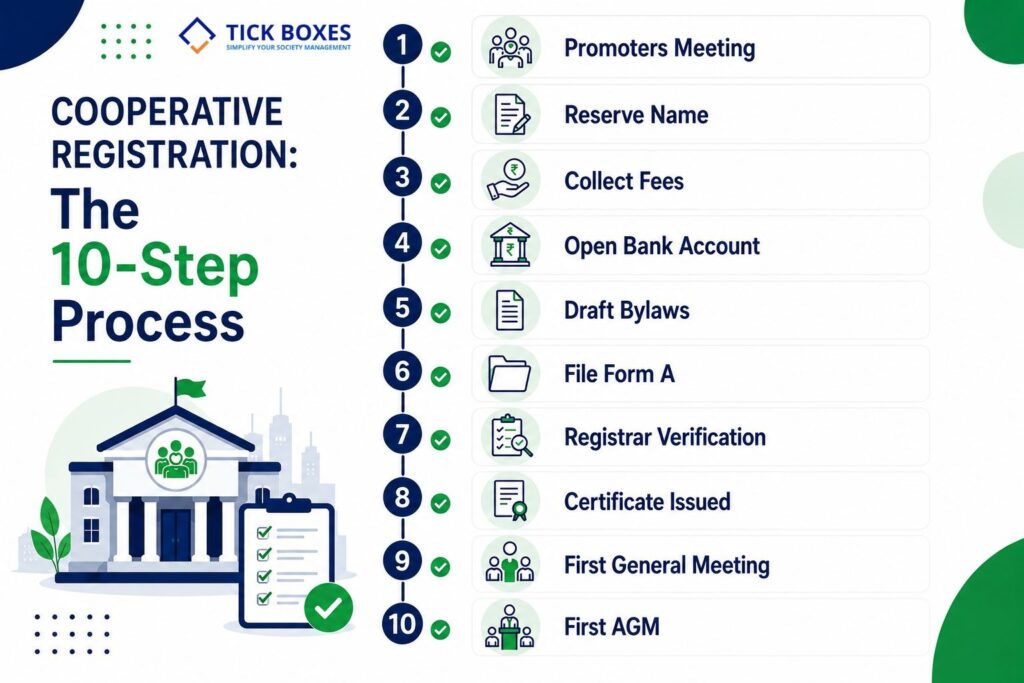
- Hold a promoters meeting. Pass resolutions to form the society, elect a Chief Promoter, and shortlist two or three alternative names.
- Apply for name reservation and bank account permission. Under Rule 106C-2 of Chapter XI-B of the MCS Rules, this application is filed in Form Y-1, along with the promoters’ resolution and minutes of the meeting that elected the Chief Promoter, plus either a commencement or completion certificate (for tenant co-partnership or premises societies) or a tentative or sanctioned layout plan (for tenant ownership societies). The Registrar must dispose of this application within 30 days.
- Collect entrance fees and share capital from all members.
- Open a provisional bank account in the Chief Promoter’s name and deposit the collected funds.
- Draft bylaws based on the applicable Model Bye-laws. Societies may formally adopt the Registrar’s model bye-laws within three months of their publication, under Rule 106C-13(1)(c).
- File the registration application within two months of name approval. Under Rule 106C-3, this is also filed in Form Y-1, signed by the Chief Promoter, along with two copies of the proposed bylaws, the list of share capital contributors, a bank certificate showing the credit balance, a scheme explaining the society’s economic viability, and the prescribed registration fee.
- The Registrar verifies the application, raises queries if needed, and may conduct an inspection.
- Registration Certificate is issued once everything is in order.
- First General Meeting is held within 3 months of registration, as required under Rule 59 of the MCS Rules, 1961. This meeting constitutes a Provisional Committee, which functions until regular elections are held under the society’s bylaws.
- Regular elections follow, typically within a year of the Provisional Committee’s formation as set out in the Model Bye-laws, after which the Working Committee takes over and the bank account is transferred into the society’s own name. (3)
What Documents Are Needed for Cooperative Housing Society Registration?
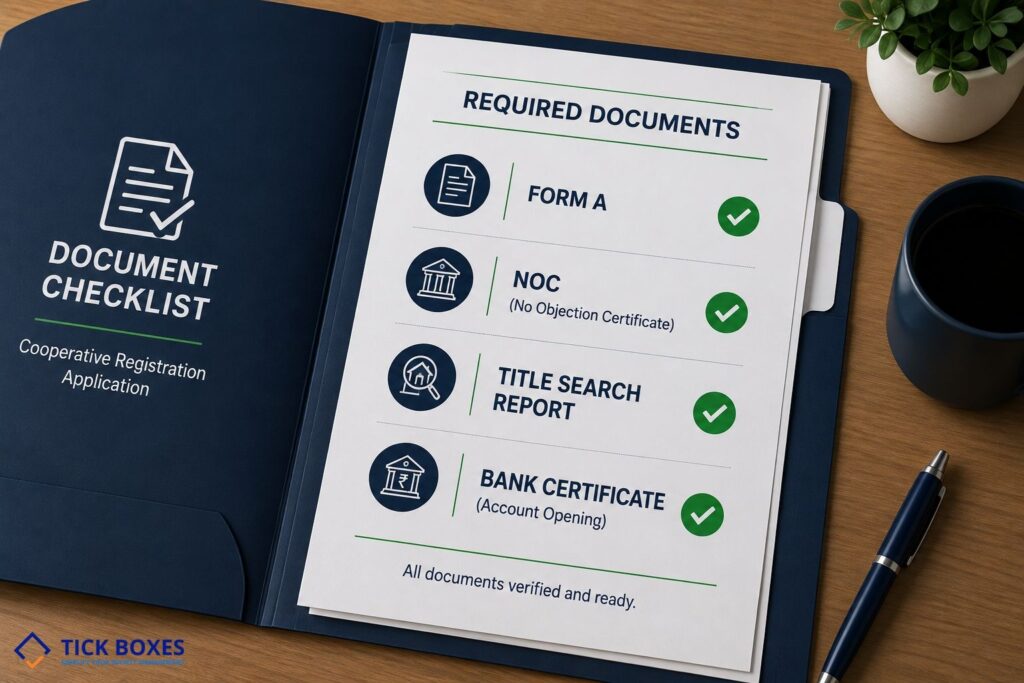
Here’s the realistic document list drawn from Rule 106C-3, not the abbreviated version that leaves committees scrambling mid process.
| Document Category | What’s Included |
| Registration form | Form Y-1, signed by the Chief Promoter |
| Society bylaws | 2 copies of the proposed bylaws |
| Share capital record | List of members who contributed share capital, the amount each contributed, and the entrance fee paid |
| Financial proof | Bank certificate showing the credit balance in the proposed society’s favour |
| Viability scheme | A scheme explaining how the society’s working will be economically sound, including details of any immovable property to be acquired or transferred to the society |
| Fee proof | Registration fee, at the rate applicable to the society’s type and size |
| Name reservation stage documents | Promoters’ resolution and meeting minutes electing the Chief Promoter, plus a commencement or completion certificate or the relevant layout plan (Rule 106C-2) |
In practice, Registrars also commonly expect supporting property documents, such as a 7/12 extract or Property Register Card, occupation and completion certificates, and a builder’s NOC where applicable, even though these sit under the broader Act rather than being listed item by item in Rule 106C-3 itself. Missing any of these is a common reason applications bounce back for resubmission.
How Much Does It Actually Cost to Register a Cooperative Housing Society?
The registration fee isn’t a single flat number. Under Rule 106C-3(2)(d) of the MCS Rules, it’s tiered by the type and size of the society.
| Society Type | Registration Fee |
| Tenant Ownership Housing Society | ₹5,000 |
| Tenant Co-partnership Society, up to 25 units | ₹2,500 |
| Tenant Co-partnership Society, 26 to 50 units | ₹5,000 |
| Tenant Co-partnership Society, 51 to 250 units | ₹7,500 |
| Tenant Co-partnership Society, above 250 units | ₹10,000 |
| Other Housing Societies | ₹5,000 |
| Housing Societies of Backward Class Persons | ₹50 |
| Housing Societies under Lok Awas Yojana | ₹50 |
| Co-operative Housing Association | ₹5,000 |
| Association of Societies | ₹5,000 |
What is the actual share capital contribution per member?
Under Rule 106C-4, admission to membership requires a minimum of five shares, at the value fixed in the society’s bylaws, plus an entrance fee of ₹500 per member. This is a meaningful figure to plan for, since older guides commonly quote a much smaller entrance fee, and getting this number wrong at the budgeting stage tends to catch new committees off guard when the actual bank deposit comes due.
How Long Does Registration Take, and What Happens If It’s Rejected?
A complete, uncontested application typically takes 30 to 60 days from filing to certificate.
What if the Registrar rejects the application?
The reasons for rejection have to be communicated directly to the Chief Promoter. From there, an appeal can be filed with the Registrar within one month of the rejection. That window matters. Missing it can mean starting the documentation process over rather than simply correcting the specific issue that caused the rejection.
What Happens Right After the Society Gets Its Registration Certificate?
Getting the certificate is not the finish line. It’s the point where a new set of obligations starts.
What happens at the First General Meeting, and what comes after?
Under Rule 59 of the MCS Rules, the Chief Promoter must convene the First General Meeting within 3 months of registration. If the Chief Promoter fails to do so, the Registrar can authorise someone else to convene it. At this meeting, the society admits new members, reviews the promoter’s transactions to date, and constitutes a Provisional Committee, which holds all the powers of a regularly elected committee until actual elections take place under the bylaws.
Elected committee members then have a separate, strict obligation: under Section 73(1AB) of the MCS Act and Rule 58-A, every elected committee member must execute a bond in Form M-20, on stamp paper, within 15 days of assuming office. Missing that window isn’t a minor slip, a member who fails to file the bond in time is deemed to have vacated the seat. It’s a step that gets missed far more often than it should, and one that quietly causes bigger problems months later when nobody can locate proof it was ever filed.
Once regular elections are held, typically within a year per the Model Bye-laws, the bank account, which had remained in the Chief Promoter’s name until this point, gets transferred into the society’s own name.
| Aspect | Provisional Committee | Regularly Elected Committee |
| Formed at | First General Meeting, within 3 months of registration (Rule 59) | Regular elections under the society’s bylaws |
| Duration | Until regular elections are held | As prescribed in the bylaws |
| Bond requirement | M-20 bond within 15 days of assuming office (Section 73(1AB), Rule 58-A) | Same M-20 requirement applies |
| Bank account status | Still in Chief Promoter’s name | Transferred to society’s name |
A Familiar Pattern: When Registration Gets Stuck Waiting on a Builder
Picture a mid-sized complex where the builder crossed the 60 percent sales mark well over a year before anyone raised the topic of society registration. Residents kept assuming it was in progress somewhere. It wasn’t. Once the flat owners finally organized, elected their own Chief Promoter, and moved forward under the Non Cooperation route, the Registrar’s formal notice to the builder actually got things moving faster than another year of informal follow up ever had.
The lesson isn’t that builders are always uncooperative. It’s that residents don’t need to sit and wait indefinitely on the assumption that someone else is handling it. Knowing the Non Cooperation path exists, and that it has real legal teeth behind it, changes how quickly a stalled registration can actually move.
Cooperative Housing Society Registration in Maharashtra vs Other States
The broad shape of registration, minimum members, a Chief Promoter, name reservation, bylaws, and an application to the Registrar, is similar across India. What differs is the level of specificity. Maharashtra has a defined builder obligation under MOFA, a codified name reservation and registration process under Chapter XI-B of the MCS Rules, a distinct M-20 bond requirement, and a clearly defined Provisional Committee mechanism under Rule 59 that aren’t always spelled out the same way in other states’ rules. Anyone registering outside Maharashtra should treat this guide as the general framework and confirm the exact fee structure, bond formats, and timelines with their own state’s cooperative department.
Registration Creates the Entity. Professional Management Creates the Experience.
Getting the certificate means a group of flat owners now legally exists as a society. It does not mean the society will actually be well run.
That distinction matters more than most newly formed committees realize. A registered society can still drift into the same problems an unregistered building had, scattered records, missed bond filings, an M-20 deadline nobody tracked, a bank account still sitting in the Chief Promoter’s name a year later because nobody scheduled the elections. Registration is a legal milestone. It is not an operating system for the years that follow.
This is exactly where a professionally managed society and a merely compliant one start to look different. One treats each of these steps, the First General Meeting, the Provisional Committee’s bond filings, the transition to regular elections, the account transfer, as a checklist to survive. The other treats them as the foundation of how the building will actually run for years afterward, with records, meetings, and transitions handled properly the first time instead of being reconstructed under pressure later.
Post-Registration Checklist for New Committees
- Confirm the Registration Certificate and the covering letter naming the officer expected to attend the First General Meeting
- Hold the First General Meeting within 3 months of registration, as required under Rule 59
- Constitute the Provisional Committee at that meeting and record its powers and functions properly
- Ensure every elected committee member files the M-20 bond within 15 days of assuming office, under Section 73(1AB) and Rule 58-A
- Schedule regular elections within the timeframe set out in the bylaws, don’t let the Provisional Committee’s term run indefinitely
- Transfer the bank account from the Chief Promoter’s name into the society’s name once the regularly elected committee is in place
- Set up expenditure authorization correctly, requiring the Chairman’s signature along with either the Secretary or Treasurer
- Start maintaining statutory registers and records from day one, not after the first audit notice arrives
Someone Has to Bridge the Gaps. That’s Not a Builder, an Auditor, or an Accountant’s Job
Here’s the part that rarely gets said plainly. A newly registered society needs several different functions to work together, correctly and on time, and none of them naturally talk to each other.
The builder’s job ends at handover, and legally, it was always about construction and conveyance, not ongoing governance. The auditor’s job is to check the books once a year, not to run the society between audits. The accountant maintains ledgers, but doesn’t sit in on committee meetings or track whether an M-20 bond deadline is approaching. None of these roles were ever meant to hold the whole picture together, and expecting a volunteer managing committee to coordinate all of them on top of their own jobs and families is where the real gaps open up, missed filings, elections that slip past their deadline, an account transfer nobody remembers to action.
Tick Boxes exist specifically to close that gap. Not as the builder, not as the auditor, not as the accountant, and not as a facility manager either, but as the team that sits across all of them, keeping the committee’s statutory obligations, financial records, and day to day operations in sync month after month, from the day the society is registered onward. That’s the difference between a society that technically exists on paper and one that actually functions well for the people living in it. That end-to-end approach, connecting registration, compliance, and ongoing management rather than leaving each in a separate silo, is what’s covered across Tick Boxes’ services.
For a society currently stuck waiting on a builder, mid registration, or recently registered and unsure what comes next, Tick Boxes are worth a conversation before small compliance gaps turn into bigger problems.
Frequently Asked Questions
A minimum of 10 members with a shared interest in the same residential property is the standard requirement across most states, including Maharashtra.
Yes. Under Section 10(1) of the Maharashtra Ownership of Flats Act, 1963, read with the applicable Rules, a builder must apply for society registration within 4 months of 60 percent of the flats in a project being sold.
Flat owners can apply directly under the Non Cooperation route. The application is filed in Form 6 under Rule 12 of the MCS Rules before the District Deputy Registrar, who is empowered under Section 10(1) of MOFA to register the society without the builder’s participation.
A Provisional Committee is constituted at the First General Meeting, held within 3 months of registration under Rule 59 of the MCS Rules. It functions until regular elections are held under the society’s bylaws.
The registration fee is tiered by society type and size under Rule 106C-3, ranging from ₹50 for Backward Class housing societies to ₹10,000 for large tenant co-partnership societies. Most mid-sized societies fall in the ₹5,000 range. On top of that, each member contributes a minimum of five shares plus a ₹500 entrance fee under Rule 106C-4.
Resources:






Add comment