
Society Accounting & Maintenance Billing
Tick Boxes manages the financial operations of your housing society end to end, from maintenance billing and bookkeeping to bank reconciliation, dues tracking, and audit-ready records.
Your Treasurer gets visibility and control without having to run the books themselves.
Our accounting function is part of a larger professional society management model, with an on-ground Society Manager, in-house accounting and audit expertise, compliance management, and connected technology working together. We currently support 100+ housing societies across Mumbai.
Book a Free Maintenance & Accounting Review →
What's Included
Accurate, itemised bills for every flat, calculated per the current bye-laws and rules.
Day book, ledger, and trial balance kept current year-round.
Monthly matching of bank statements with the society ledger.
Maintaining current authorised-signatory documentation.
Monitoring balances and movement across designated funds.
Maintaining an audit trail for approved payments.
Income and expenditure statement, balance sheet, ready for AGM and audit.
Arrears list with correctly applied interest, updated monthly.
GST treatment assessed and applied based on the society's registration status, turnover, and applicable exemption conditions.
Contractor and vendor payables recorded against the correct budget head.
Who This Is For
Built for committees currently running finances through scattered spreadsheets, a part-time bookkeeper, or whoever on the committee happens to be good with numbers. It's equally useful for societies that already have an accountant but need billing structures reviewed and updated for the 2026 rule changes, a gap we're seeing across many Mumbai societies right now.

Important: What Changed in the 2026 MCS Rules
The Maharashtra Co-operative Societies (Amendment) Rules, 2026, notified 18th June 2026 and effective from 30th June 2026, changed how maintenance bills must be calculated. If your society's billing hasn't been updated, it may no longer be compliant.
| What changed | 2014 Model Bye-Laws | 2026 Rule 106C-12 |
|---|---|---|
| Interest on overdue dues | 21% simple interest p.a., or a lower rate fixed by the General Body | ChangedMaximum 12% simple interest p.a. |
| Non-occupancy charges | Up to 10% of service charges, subject to the applicable Government direction | Changed10% of service charges |
| Service charges | Equal per flat/unit | UnchangedEqual per flat/unit |
| Sinking Fund | Minimum 0.25% p.a. of construction cost of each flat/unit | UnchangedMinimum 0.25% p.a. of construction cost of each flat/unit |
| Repair & Maintenance Fund | Minimum 0.75% p.a. of construction cost of each flat/unit | UnchangedMinimum 0.75% p.a. of construction cost of each flat/unit |
| Major Repair Fund | Pro-rata on area basis, as required and decided by the General Body | ChangedBased on carpet area of each flat/unit |
Societies still billing at the old 21% rate may find those resolutions unenforceable during recovery proceedings. We review and update billing structures to keep them aligned with the current rules.
What Goes Into a Maintenance Bill
A society maintenance bill isn't one lump sum, it's a set of components, each governed by the bye-laws:
| Component | Basis |
|---|---|
| Service charges | Equal per flat (per 2026 rules) |
| Sinking fund | Carpet area |
| Repair & Major Repair Fund | Carpet area |
| Water charges | Per inlet / consumption |
| Non-occupancy charges | Max 10% of service charges, rented flats only |
| Parking charges | As fixed by General Body |
| Property tax | As levied, apportioned by carpet area on common areas |
| Interest on arrears | Max 12% simple interest p.a. |
We generate and issue itemised bills reflecting exactly this breakdown, so members always know what they're paying for and why, and disputes over "unclear charges", one of the most common sources of committee-resident friction, drop sharply once billing is transparent.
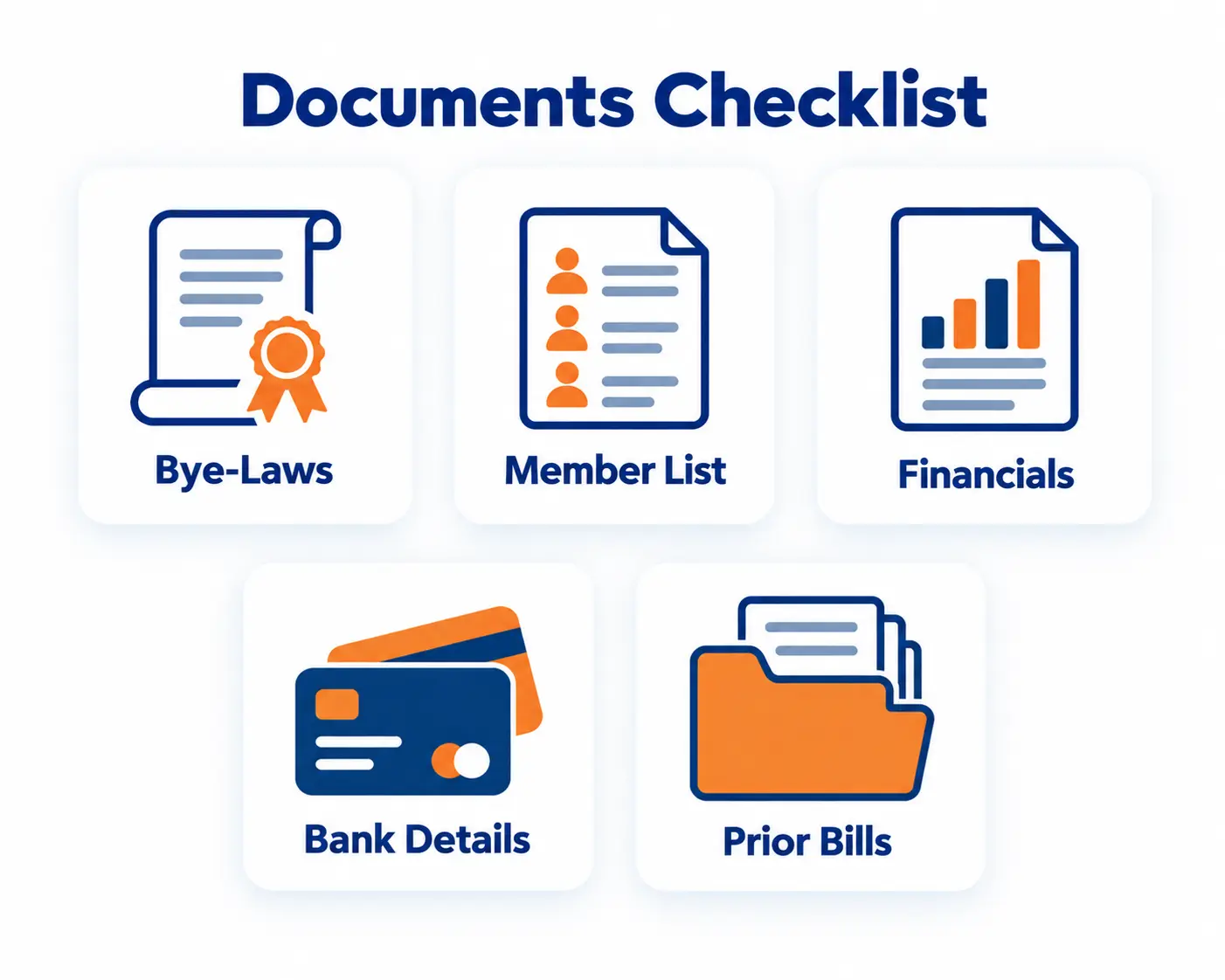
Documents We'll Typically Need
- Society registration certificate and current bye-laws
- Member list with unit-wise carpet area
- Last audited financial statements
- Existing bank account details and signatory list
- Prior maintenance billing structure, if any
Managing Your Society's Bank Account
A society's bank account isn't run like a personal one, it needs documented authority and a clean audit trail.
As approved by the Managing Committee, updated whenever the committee changes.
Society money stays separate from any individual's personal account, always.
Bank statements matched against the ledger, discrepancies flagged early.
Sinking and repair fund balances placed in interest-bearing deposits with cooperative or scheduled banks, tracked against Section 80P eligibility.
We handle this reconciliation as a standing part of our service, not a once-a-year audit scramble.
Why Tickboxes
Finance isn't a spreadsheet we hand back once a year. It's tracked continuously, connected to your compliance filings and audit records, so nothing gets missed when a rule changes mid-year, the way it did on June 30, 2026. Backed by a team in Andheri West, we make sure your society's billing stays accurate and current, not stuck on a rate that stopped being applicable months ago.
Your Treasurer shouldn't have to become your society's accountant. Tick Boxes' accounting team handles the day-to-day financial administration, while your committee retains visibility, approval, and oversight. Every bill, payment, reconciliation, fund movement, and outstanding amount is tracked continuously, so your committee isn't discovering problems at audit or AGM time.
Because we're not your builder, your auditor, your accountant, or your facility manager, we're the ones who sit across all of them, keeping your society's numbers, filings, and day-to-day operations in sync instead of scattered across four different people who were never meant to talk to each other.
Because registration only makes your society legally exist. We're what makes it actually run well.

Frequently Asked Questions
1. What are the components of a housing society maintenance bill?
Service charges, sinking fund, repair and major repair fund, water charges, non-occupancy charges (where applicable), parking, property tax, and interest on arrears, each governed by specific bye-laws.
2. Has the interest rate on late maintenance payments changed in 2026?
Yes. Under the MCS (Amendment) Rules 2026, effective 30th June 2026, the maximum interest a society can charge on overdue dues is now 12% simple interest per annum, down from the earlier 21%.
3. Can a housing society charge maintenance based on flat size?
Service charges must now be split equally per flat regardless of size, under the 2026 rules. Other components, like the sinking fund and repair fund, are still calculated on carpet area.
4. Who is authorised to operate a housing society's bank account?
Only signatories approved by the Managing Committee, as recorded in meeting minutes, never an individual member acting alone.
5. What is the non-occupancy charge cap for rented flats?
Non-occupancy charges are capped at 10% of the service charge amount under the 2026 rules, applicable only to rented (not vacant) flats.