
Quick answer: To register a housing society in Maharashtra, at least 10 members must apply under the Maharashtra Cooperative Societies Act, 1960. The process includes name reservation, opening a bank account, filing Form A with the Deputy Registrar, and receiving a Certificate of Registration, usually within 6 to 8 weeks.
A few things worth knowing before diving in:
- Minimum 10 members are required, not 7, as a few websites incorrectly state
- The government fee is around ₹2,500, but the real total cost usually lands between ₹10,000 and ₹35,000 once share capital, stamp duty, and documentation are added in
- The standard timeline is 6 to 8 weeks, but a provision called Deemed Registration kicks in if the Registrar sits on the file for more than 2 months
- The application is filed in Form A with the Deputy Registrar of Cooperative Societies
- A society’s registration is not permanent by default. Under Section 21-A of the MCS Act, the Registrar can cancel it if the society stops operating as per its bylaws
A Building Full of Good Intentions, and One Missing Signature
Most groups forming a society get almost everything right. The residents agree, the paperwork gets photocopied, someone volunteers to be the point person, and the file goes in with genuine confidence. And then, three weeks later, it comes back. Not because the society did something wrong on paper, but because nobody checked whether the person who signed as Chief Promoter actually had their name on a sale deed.
That single gap, a Chief Promoter who technically wasn’t eligible to hold that role, is one of the most common reasons registration applications stall in Maharashtra. It rarely gets flagged in generic guides because it sounds like a small detail. On the ground, it is the difference between a society getting its certificate in 7 weeks or getting stuck in a loop of resubmissions for months.
This is the kind of thing that separates reading the Maharashtra Cooperative Societies Act from actually walking a committee through it.(1) What follows is the real sequence, the real documents, the real cost (not just the fee everyone quotes), and the exact points where committees tend to lose time.
What Is Housing Society Registration and Why Does It Matter?
Housing society registration is the legal process of establishing a residential building or complex as a cooperative body under the Maharashtra Cooperative Societies Act, 1960. Once registered, the society becomes a legal entity in its own right. It can open a bank account in its own name, sign contracts with vendors, take loans for repairs or redevelopment, and represent itself in disputes rather than relying on informal, undocumented arrangements between residents.(2)
What happens if a residential building never registers as a society?
Without registration, there is no legal body to hold funds, sign agreements, or be held accountable for how common money is spent. Maintenance collection stays informal, vendor contracts get signed in individual names, and there is no structure for resolving disputes if something goes wrong. Most buildings eventually register precisely because informal management becomes unsustainable once the building crosses a certain size or age.
Who Can Register a Housing Society in Maharashtra?
A minimum of 10 members, or a majority of flat owners in the building, whichever applies, is required to register a cooperative housing society in Maharashtra.
How is the Chief Promoter actually selected?
In practice, this is not a formality. A shortlist of interested members is discussed at the preliminary meeting, and one person is elected by majority vote to act as Chief Promoter. That person becomes the face of the entire registration process, responsible for filing the application and coordinating documents. Picking someone purely because they have free time, without checking their eligibility as a titleholder, is where a lot of applications run into trouble later. It is worth treating this decision with the same seriousness as electing a managing committee member.
What Is the Step by Step Housing Society Registration Process in Maharashtra?
- Hold a preliminary meeting. Gather the interested members, pass a formal resolution to form the society, and document it in writing.
- Elect a Chief Promoter by majority vote among the provisional committee.
- Reserve a name with the Department of Cooperation, Marketing and Textiles, along with two backup options in case the first choice conflicts with an existing society.
- Collect entrance fees and share capital from prospective members, a statutory requirement before the bank account step.
- Open a provisional bank account in the society’s proposed name within 3 months of name approval. This money cannot be withdrawn until registration is complete.
- Draft the bylaws, based on the current Model Bye-laws, and get at least 10 promoter members to sign off on them.
- Compile documents and file Form A, along with Annexures A, B, and C, at the office of the Deputy Registrar of Cooperative Societies.
- Get an acknowledgement. The application is logged in Register B with a serial number, and members receive a receipt to track its status.
- Registrar verification. Documents are checked for authenticity, and existing societies nearby get a window to raise objections if relevant.
- Approval and certificate. Once satisfied, the Registrar logs the entry in Register D, issues the Certificate of Registration, and notifies the registration in the official gazette.
What Documents Are Required for Housing Society Registration?
Documentation is where most delays actually happen, not the process itself. Here is what typically needs to go in with the application.
| Document Category | What’s Included | Copies Needed |
| Registration form | Form A with Annexures A, B, and C | 4 copies |
| Society bylaws | Drafted as per Model Bye-laws | 4 copies |
| Financial proof | Bank balance certificate | Original |
| Property documents | 7/12 extract or Property Register Card, approved building plan, occupation and completion certificates | 2 copies each |
| Member details | List of promoter members with ID and address proof | As applicable |
| Legal documents | Statement of accounts, advocate’s affidavit or certificate, notarized indemnity bond | As applicable |
| Fee proof | Registration fee challan (around ₹2,500) | Original |
Missing even one of these, particularly the occupation certificate or a complete promoter list, is one of the fastest ways to get an application returned for resubmission.
How Much Does Housing Society Registration Actually Cost in Maharashtra?
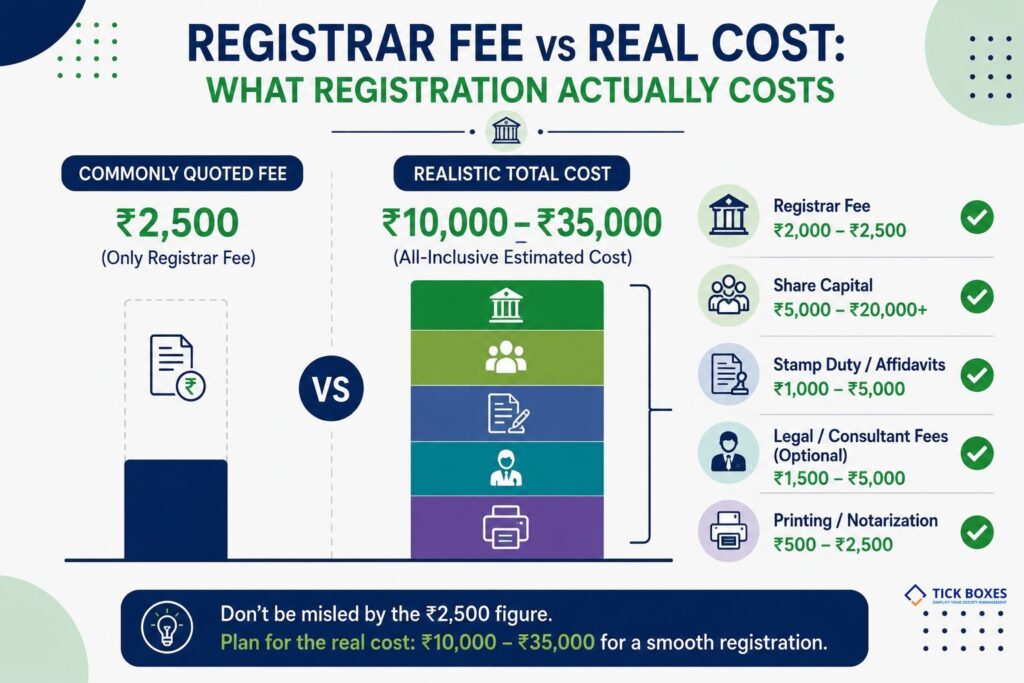
The Registrar’s fee is fixed at around ₹2,500. That figure gets repeated across the internet as if it’s the total cost of registration, and it simply isn’t.
Why do most estimates only mention ₹2,000 to ₹5,000?
That number covers only the government fee paid to the Registrar. It leaves out share capital contribution, stamp duty on affidavits and indemnity bonds, notarization, printing, and, if the committee chooses to bring in legal or consultant support, professional fees on top of that. Once all of it is added up, a more realistic total for most societies falls between ₹10,000 and ₹35,000, depending on the number of members and whether professional assistance is used.
| Cost Component | Amount | Included in the commonly quoted ₹2,000 to ₹5,000 figure? |
| Registrar fee | ₹2,500 | Yes |
| Share capital contribution | ₹50 to ₹100 per member | No |
| Stamp duty, affidavits, indemnity bond | ₹1,000 to ₹5,000 | No |
| Legal or consultant assistance (optional) | ₹5,000 to ₹25,000 | No |
| Printing, notarization, filing costs | ₹1,000 to ₹3,000 | No |
| Realistic total | ₹10,000 to ₹35,000+ |
Budgeting for the real number upfront saves committees from an awkward mid-process scramble for extra funds.
How Long Does Housing Society Registration Take?
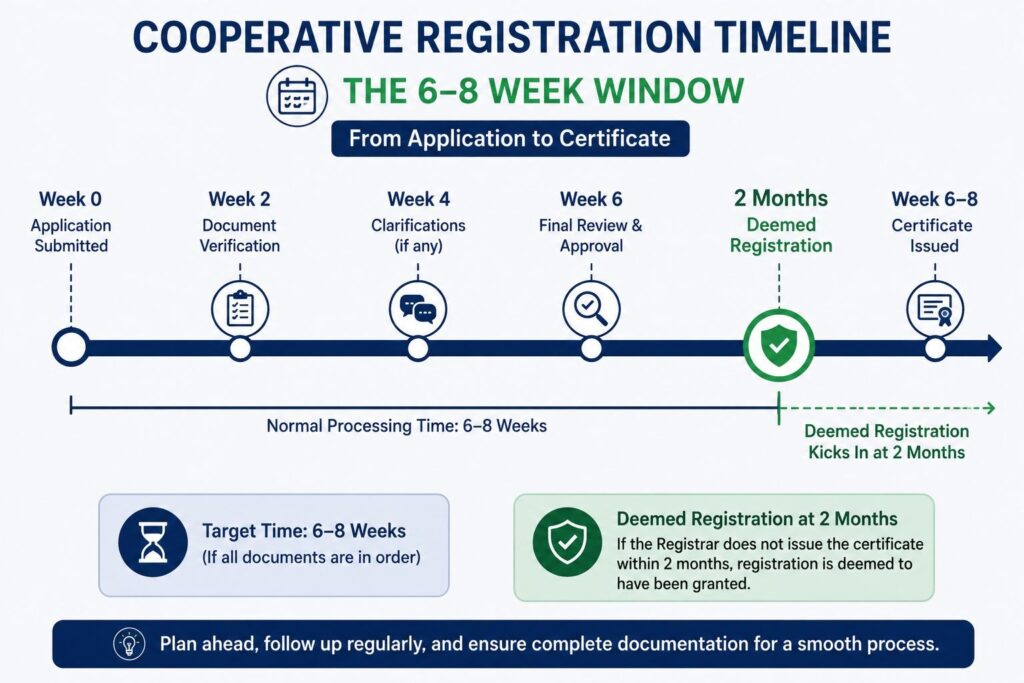
Registration typically takes 6 to 8 weeks from the date the application is filed, assuming documents are complete and there are no objections.
What is Deemed Registration, and why does it matter?
If the Registrar does not act on a complete application within 2 months of receiving it, the society is automatically considered registered under a provision called Deemed Registration, and the Registrar becomes legally bound to issue the certificate. Very few committees know this exists, which means very few ever use it to push back on an unexplained delay. It is one of the more useful protections written into the process, and it is worth diarizing that two month mark the day the application is filed.
What Happens If the Registrar Rejects the Application?
If an application is rejected, the reasons have to be communicated in writing to the Chief Promoter, and the Registrar files Form C, forwarding the matter to the government at Mantralaya.
Common rejection reasons seen on the ground
- The proposed name conflicts with an existing registered society
- The occupation certificate is missing or incomplete
- The promoter list has gaps, or a promoter’s eligibility cannot be verified against title documents
- The bylaws do not align with the current Model Bye-laws
Can a rejected application be corrected and resubmitted?
Yes. Most rejections are procedural rather than final. Once the specific gap is addressed, whether that’s a document, a name conflict, or a bylaw correction, the application can be refiled. The key is treating the rejection reasons as a checklist rather than a setback.
Can a Housing Society Lose Its Registration After Getting It?
Registration is not a one time event that guarantees permanent status. Under Section 21-A of the Maharashtra Cooperative Societies Act, the Registrar has the power to cancel a society’s registration if it stops functioning according to its approved bylaws.
This is exactly why what happens after the certificate arrives matters just as much as the registration process itself. Regular AGMs, proper statutory records, and timely audits are not optional extras, they are what keeps that registration valid year after year. Many of the recurring issues societies run into after registration, from delayed maintenance collection to disputes between committee members, come down to gaps in this ongoing compliance. A closer look at how these problems typically show up, and how committees have worked through them, is covered in this breakdown of common challenges in housing societies.
Is Housing Society Registration Available Online in Maharashtra?
Name reservation and application status tracking can be done through the state cooperation department’s online portal. Original documents, bank certificates, and physical verification, however, typically still require an in person visit to the Registrar’s office. Anyone expecting the entire process to be paperless from start to finish will end up disappointed. Planning for at least one or two physical submissions keeps expectations realistic.
Pre-Registration Checklist for Managing Committees
- Confirm at least 10 members, or a majority of flat owners, are willing to be promoters
- Verify each promoter’s name appears on a valid sale deed or allotment letter
- Hold and formally minute the preliminary meeting, do not skip the written resolution
- Elect the Chief Promoter through a documented majority vote
- Shortlist two or three backup names before applying for name reservation
- Collect entrance fees and share capital before attempting to open the bank account
- Open the provisional bank account within 3 months of name approval
- Draft bylaws against the current Model Bye-laws, not an outdated template
- Cross check the document list, particularly the 7/12 extract and occupation certificate, before filing
- Note the application’s serial number from Register B for follow up
- Mark the 2 month date on the calendar in case Deemed Registration becomes relevant
Registration Is the Starting Point, Not the Finish Line
Getting the certificate feels like the finish line, but it is really the point where the real work of running a society begins. Bylaws need to be followed, records need to be maintained, and the same Section 21-A that protects a society’s legal status can just as easily be used to cancel it if compliance slips.
Tick Boxes has supported housing societies through this exact process across Maharashtra, not from behind a support ticket, but through people who understand what a Registrar’s office actually expects on the day documents get filed. That same operational depth carries into what happens after registration, statutory compliance, accounting, and day to day committee support, the kind of work covered across Tick Boxes’ services and the communities Tick Boxes already works with, visible on the where we work page.
For committees currently forming a society, or one that’s registered but struggling to stay compliant, getting the right guidance early costs far less than fixing an avoidable delay later.
Reach out to Tick Boxes to talk through where the process stands.
Frequently Asked Questions
1. How many members are needed to register a housing society in Maharashtra?
A minimum of 10 members, or a majority of flat owners in the building, whichever applies, are required to register a cooperative housing society in Maharashtra.
2. How long does it take to register a housing society in Maharashtra?
Registration typically takes 6 to 8 weeks. If the Registrar does not act within 2 months of receiving the application, the society is automatically considered registered under the Deemed Registration provision.
3. What is the actual cost of registering a housing society in Maharashtra?
The Registrar’s fee is fixed at around ₹2,500, but the realistic total cost, including share capital, stamp duty, and documentation, usually falls between ₹10,000 and ₹35,000.
4. Can housing society registration be done online in Maharashtra?
Name reservation and application status tracking can be done through the state cooperation department’s online portal, but original documents and bank certificates still typically require physical submission.
5. Can a registered housing society lose its registration?
Yes. Under Section 21-A of the Maharashtra Cooperative Societies Act, 1960, the Registrar has the power to cancel a society’s registration if it fails to operate as per its approved bylaws.
Resources:



Add comment