
Quick answer: A housing society audit is a yearly statutory check of financial records and compliance, required under the Cooperative Societies Act of the relevant state. In Maharashtra, it must be completed within four months of the financial year’s close, by July 31, by an auditor from the Registrar’s approved panel.
A few things worth knowing before diving in:
- Every state’s Cooperative Societies Act makes an annual audit mandatory, though exact deadlines and forms vary by state
- In Maharashtra, the deadline is July 31, four months after the financial year ends, under Section 81 and Rule 69
- The audit covers cash books, bank statements, member ledgers, sinking and repair fund usage, and TDS or GST compliance on vendor bills
- The auditor must come from a Registrar approved panel and generally cannot serve the same society for more than a three years
- The audit report is presented at the society’s Annual General Meeting, which in Maharashtra must be held by September 30
Here’s what most committees don’t realize until the deadline is already breathing down their neck.

The Society That Learned Why Audits Matter
A housing society can assume the audit is a formality right up until it isn’t, and then discover just how much can go wrong once the process actually gets contested.
In 2014, the Times of India reported that re-audits ordered by the Joint Registrar for three Navi Mumbai societies had reached a complete standstill.(1) These weren’t routine first-time audits, they were re-audits, meaning something in the original process had already raised enough concern for the Registrar’s office to step in and demand a second look, and even that second look couldn’t move forward. Cases like this rarely start with dramatic fraud. They start with unresolved objections, incomplete cooperation, or records that were never in a state to withstand real scrutiny in the first place, and by the time a re-audit gets ordered, the society is already dealing with a far messier, slower process than a straightforward annual check would have been.
This isn’t a Mumbai problem or a Maharashtra problem. Every housing society in India, wherever it’s registered, manages money on behalf of residents through a common account, and that’s exactly why audits exist. The specific deadlines and procedures shift by state, Maharashtra sets these out with particular precision, so it’s used as the working example throughout this guide, but the underlying gap is the same everywhere: managing committees are volunteers, not full-time accountants, auditors, or compliance officers, and expecting them to single-handedly keep a year’s worth of records audit-ready is where most of these gaps come from.
What Is a Housing Society Audit, Exactly?
A housing society audit is a mandatory yearly review of a society’s financial records and regulatory compliance, carried out by a government approved auditor, required under the Cooperative Societies Act of the state the society is registered in.
Is the audit only about money, or does it check governance too?
Both. The financial side covers whether income and expenses are accurately recorded and funds are being used the way they’re supposed to be. The governance side checks whether the managing committee is actually following its own bylaws and meeting its statutory obligations, not just whether the numbers add up.
Is a Housing Society Audit Mandatory in Every State?
Yes, in principle. Every state’s Cooperative Societies Act carries some version of a mandatory annual audit requirement for registered societies. What changes from state to state is the exact deadline, the prescribed forms, and some of the procedural details.
How does Maharashtra’s deadline actually work?
Maharashtra spells this out with unusual precision. Under Section 81(1)(a) of the Maharashtra Cooperative Societies Act, 1960, and Rule 69 of the accompanying Rules, the audit has to be completed within four months of the financial year’s close, which lands on July 31 for most societies.(2) If a society is registered in another state, the safest move is confirming the exact date directly with the local Registrar’s office rather than assuming Maharashtra’s calendar applies.
Who Is Allowed to Audit a Housing Society?
The auditor or auditing firm has to be appointed by the society at its Annual General Meeting, and selected from the Registrar’s approved panel, meeting whatever qualifications the state prescribes.
Can the same auditor be reappointed every year?
Not indefinitely. In Maharashtra, the same auditor cannot audit a society for more than three consecutive years, a rotation rule that surprises a lot of committees who’ve quietly kept the same auditor on for five or six years running without realizing it’s a compliance gap waiting to be noticed. Other states tend to carry a similar rotation principle, even where the exact cap differs.
What Does a Housing Society Audit Actually Cover?
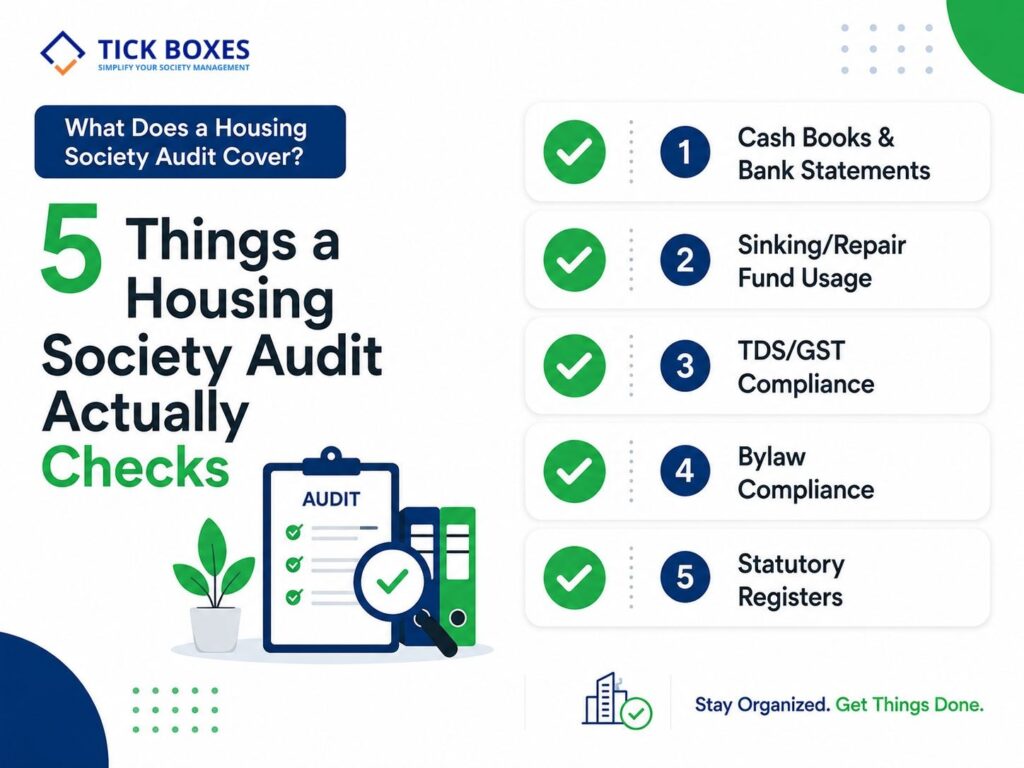
Strip away the paperwork and the audit is really checking five things.
- Cash books, bank statements, and member ledgers, to confirm the money trail matches what actually happened
- Sinking fund and repair fund utilization, to confirm long term reserves aren’t quietly being spent on short term needs
- TDS and GST compliance on vendor and contractor payments, an area that gets missed more often than committees expect
- Bylaw compliance, whether the managing committee’s actual conduct matches what it’s supposed to be doing
- Statutory registers: share and nomination registers, property and asset registers, minutes books, and investment records
Every one of these applies regardless of which state a society sits in. The specific forms and deadlines shift, the underlying checklist doesn’t.
What Happens If the Audit Finds Defects or Irregularities?
Societies generally get a defined window after the audit report to explain and correct whatever gets flagged.
How does this play out in Maharashtra specifically?
Under Section 82 of the MCS Act, the society has three months from the date of the audit report to explain the identified defects to the Registrar and report the corrective action it has taken. Missing that window and a minor flag can turn into a bigger compliance headache.(3)
What if members suspect mismanagement beyond what the audit shows?
There’s an escalation path most residents never learn about until they need it. Under Section 83, one third of a society’s members in Maharashtra can formally demand that the Registrar hold an inquiry into the society’s constitution, working, and financial condition. Most other states carry a comparable member driven inquiry provision under their own Act, even if the exact threshold differs.
How Does the Audit Connect to the AGM?
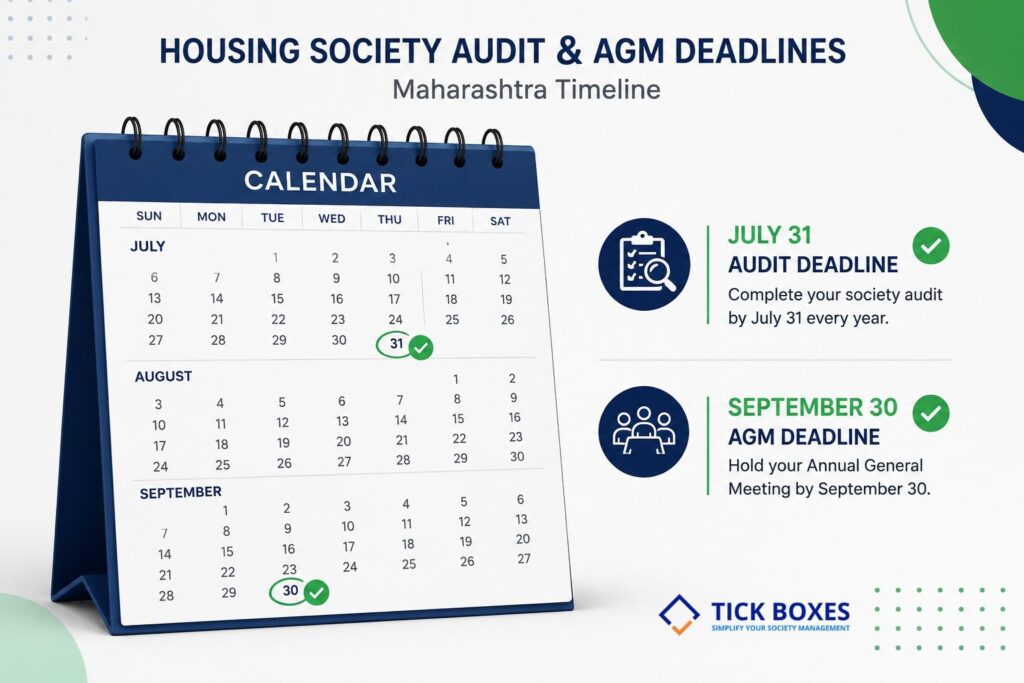
The audit report has to be presented at the society’s Annual General Meeting. In Maharashtra, that AGM itself must be held by September 30, giving committees a tight window between the July 31 audit deadline and the meeting where the report gets formally reviewed.
What should members actually look for when the report is presented?
Check whether fund utilization lines up with the approved budget for the year. Confirm TDS and GST filings show up where they should. And read any auditor remarks or flagged irregularities carefully before voting to approve the report, since approval at the AGM effectively closes the books on that financial year.
Audit Compliant Versus Professionally Managed: What’s the Real Difference?
Being audit compliant means a society technically ticks the legal boxes, an auditor was appointed, a report got filed, the AGM happened before the deadline. It says nothing about how the eleven months before that audit were actually run.
A professionally managed society looks completely different from the inside. Records are reconciled monthly, not scrambled together in the final weeks before July 31. Vendor payments carry documentation from day one, not retrofitted after an auditor asks for it. The committee walks into its AGM already knowing what the report will say, instead of finding out in the room along with everyone else. The gap between these two societies rarely shows up as a difference in whether the audit gets passed. It shows up in how many sleepless weeks the committee spends getting there, and how confident residents feel that their money was actually handled well, not just technically accounted for.
| Aspect | Audit Compliant Only | Professionally Managed and Audit-Ready |
| Record keeping | Reconstructed before the deadline | Maintained continuously through the year |
| Vendor documentation | Chased down when the auditor asks | Filed and matched at the time of payment |
| Committee’s audit-day experience | Reactive, answering unexpected questions | Prepared, already aware of the numbers |
| Member trust | Built on the audit passing, nothing more | Built on visible, ongoing transparency |
| Time cost to the committee | Concentrated, stressful crunch | Spread evenly, manageable |
Closing the Gap Between Accountants, Auditors, Facility Teams, and the Committee
Here’s the part that rarely gets said out loud. A society’s finances don’t sit in one place. The accountant maintains the books. The auditor checks them once a year. The facility team generates the vendor bills, AMC records, and maintenance expenses that feed into those books in the first place. And the managing committee, made up of residents with full-time jobs of their own, is expected to sit at the center of all four and make sure everything lines up.
That’s an enormous ask for a volunteer body, and it’s exactly the gap that causes cases like the Navi Mumbai one. Nobody was dishonest. Nobody was even careless in an obvious way. Records simply lived in different hands, updated at different times, with no single thread tying them together consistently across the year.
This is the actual value of professional, end-to-end society management, not software that generates a bill, but a team that sits across the accountant, the auditor, the facility vendors, and the committee, keeping all four in sync month after month rather than reconciling them under deadline pressure once a year. Tick Boxes was built around exactly this role.
What Should a Committee Do Before the Auditor Arrives?
- Confirm your state’s exact audit deadline with the local Registrar; Maharashtra’s is July 31, four months after year end
- Confirm the appointed auditor is on the approved panel and hasn’t exceeded the permitted consecutive year limit
- Hand over books of accounts to the auditor promptly after year end close, well before the deadline
- Reconcile cash books and bank statements before the auditor’s review, not during it
- Pull together sinking fund and repair fund utilization records for the full financial year
- Verify TDS and GST deductions on all vendor and contractor payments are documented
- Update statutory registers, share, nomination, property, minutes, and investment, so they’re current, not retroactively filled in
- Diarize the audit completion deadline and the AGM deadline separately
- If the audit flags defects, prepare the Registrar explanation and rectification plan well within the applicable window
The Audit Is a Mirror, Not an Obstacle
The Navi Mumbai re-audits are a reminder of what happens when that formal check doesn’t go smoothly the first time. What starts as a routine audit can turn into a drawn-out re-audit, formal objections, and months of back and forth with the Registrar’s office, all because the underlying records weren’t solid enough to hold up to a closer look. That risk isn’t unique to one building or one city. It applies wherever residents have pooled their maintenance money into a shared account, whether that’s in Thane, Pune, Bengaluru, or anywhere else.
Compliance is the minimum bar. What actually gives a committee peace of mind, and gives residents real confidence in how their money is handled, is professional governance that holds up long before the auditor walks in. Tick Boxes works with societies to keep books, vendor records, and statutory registers continuously audit-ready, bridging the accountant, the auditor, and the facility side of operations so the committee isn’t left holding all of it together alone. That end-to-end approach, transparency built in month by month rather than assembled in a rush, is what’s covered across Tick Boxes’ services.
If a committee wants its next audit to be a formality rather than a fire drill, it’s worth a conversation with Tick Boxes well before the deadline arrives.
Frequently Asked Questions
1. Is a housing society audit mandatory every year?
Yes. Every state’s Cooperative Societies Act requires societies to get their accounts audited at least once each financial year. In Maharashtra, this falls under Section 81 of the MCS Act, 1960.
2. What is the deadline for a housing society audit?
Deadlines vary by state. In Maharashtra, the audit must be completed by July 31, four months after the financial year ends, under Section 81 and Rule 69 of the MCS Rules, 1961.
3. Who can audit a housing society’s accounts?
An auditor or auditing firm appointed by the society at its AGM from the Registrar’s approved panel, meeting the prescribed qualifications. In Maharashtra, the same auditor cannot serve more than three consecutive years.
4. What happens if the audit report finds irregularities?
The society typically has a set window, three months in Maharashtra under Section 82, to explain the defects to the Registrar and take corrective action.
5. Can members request a special inquiry if they suspect financial mismanagement?
Yes. In Maharashtra, under Section 83, one third of a society’s members can formally demand that the Registrar hold an inquiry into the society’s constitution, working, and financial condition. Most other states carry a comparable provision under their own cooperative societies law.
Resources:


Add comment